Background
Ceftriaxone (CRO) shows promising anti-treponemal activity. However, its efficacy for people with early syphilis who often have coexisting bacterial sexually transmitted infections (STIs) remains unclear. This study aimed to compare the efficacy with 1-g, single-dose CRO plus 7-day doxycycline (Doxy) (CRO/Doxy) vs 2.4-MU, single-dose benzathine penicillin G (BPG) plus 7-day Doxy (BPG/Doxy) for the treatment of early syphilis among people with HIV (PWH).
Methods
In this pilot randomized clinical trial, eligible participants with early syphilis were randomized in a 1:1 ratio to receive CRO/Doxy or BPG/Doxy. The rapid plasma reagin (RPR) titers were determined at baseline and at weeks 4, 12, 24, 36 and 48. PCR assays for the detection of Treponema pallidum DNA (TP-DNA) and other bacterial STIs (including chlamydia, gonorrhea, and Mycoplasma genitalium) were performed at baseline, with follow-up PCR assays performed for TP-DNA and for other STIs at week 4. In the intention-to-treat (ITT) analysis, participants with conditions requiring additional antibiotics active against T. pallidum were excluded. The primary outcomes were the serologic responses of syphilis, defined as a 4-fold or greater decline of RPR titer at weeks 24 and 48, respectively. The secondary outcomes were serologic responses of syphilis at weeks 12 and 36, and microbiologic responses assessed by PCR assays.
Results
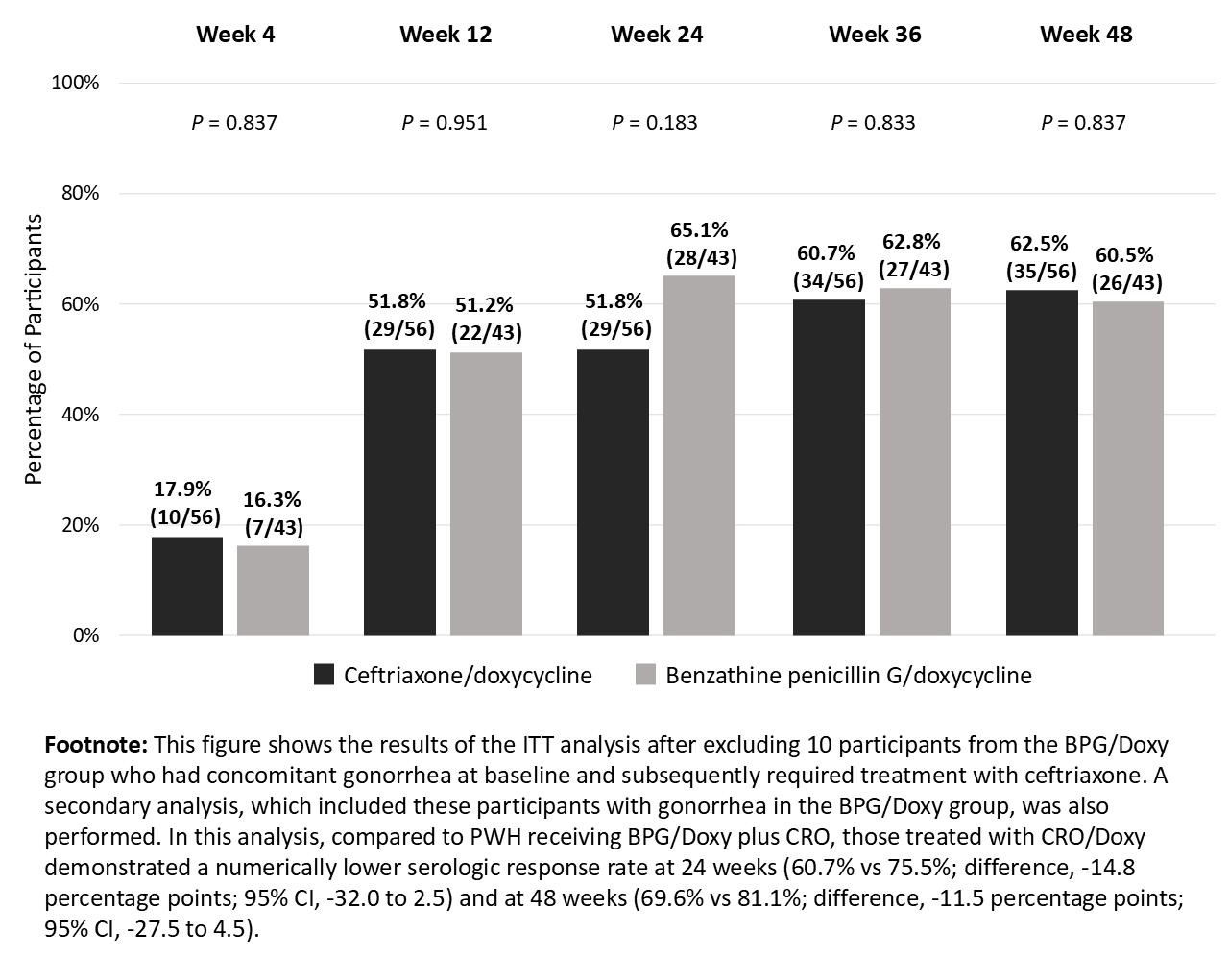
From March 2023 to September 2024, 56 and 53 PWH (100% MSM; median age and CD4 count, 39 years and 558 cells/mm3, respectively) with early syphilis were randomized to receive CRO/Doxy and BPG/Doxy, respectively. At baseline, co-infection rates were 31.2% (n=34) for chlamydia and 13.8% (n=15) for gonorrhea. In the ITT analysis, PWH receiving CRO/Doxy showed a numerically lower serologic response rate at 24 weeks compared to those receiving BPG/Doxy (51.8% vs 65.1%; difference, -13.3 percentage points; 95% CI, -32.7 to 6.0); however, at 48 weeks, the response rate was numerically higher in the CRO/Doxy group than in the BPG/Doxy group (62.5% vs 60.5%; difference, 2.0 percentage points; 95% CI, -17.3 to 21.4) (Figure). At week 4, the microbiologic responses of syphilis and chlamydia were similar between the two groups.
Conclusions
In the ITT analysis of serologic response, the efficacy of CRO/Doxy was non-inferior to that of BPG/Doxy among PWH with early syphilis during 24- and 48-week follow-up periods, supporting further investigations of large sample sizes to confirm the efficacy of the two treatment regimens.
Table or Figure