Background
Generic tenofovir-disoproxil-fumarate/emtricitabine (TDF-FTC) is cost-effective compared to tenofovir-alafenamide/emtricitabine (TAF-FTC) for HIV pre-exposure prophylaxis (PrEP) among US young men who have sex with men (YMSM). Despite high cost, 37% of providers prescribe TAF-FTC over TDF-FTC for YMSM, in part due to uncertainty around TDF-FTC adverse events (AEs) among adolescents.
Methods
Using the CEPAC-Adolescent microsimulation model, we apply value of information (VOI) and implementation (VOM) frameworks to project the incremental net monetary benefit (NMB=difference in health benefits and costs at a willingness-to-pay threshold) of decision-making after and before a hypothetical study that would provide information about AEs. We simulate US YMSM on PrEP (n=48,300), with two daily oral PrEP strategies: TDF-FTC and TAF-FTC. Inputs include pre/post study uptake (TDF-FTC=63%/94%, TAF-FTC=37%/6%); TDF-FTC bone fracture incidence (18.7/1000 person-years (PY), range=0-37.5); TAF-FTC hypertension incidence (0.37/1000PY, range=0.23-0.58); PrEP adherence (46%); and monthly costs (TDF-FTC=$196, TAF-FTC=$1,706). Projected 10-year outcomes include incremental cost-effectiveness ratios (ICERs, $/quality-adjusted life years [QALY], discounted 3%/year), VOI (incremental NMB of reducing AE uncertainty) and VOM (incremental NMB of increasing optimal strategy uptake). We examine a range of willingness-to-pay thresholds ($50K–$500K/QALY, $100K in VOM analysis) and expanding PrEP use to all YMSM with PrEP indications (n=196,800). In probabilistic sensitivity analyses (PSA), we vary incidence of HIV, fractures and hypertension, and PrEP adherence.
Results
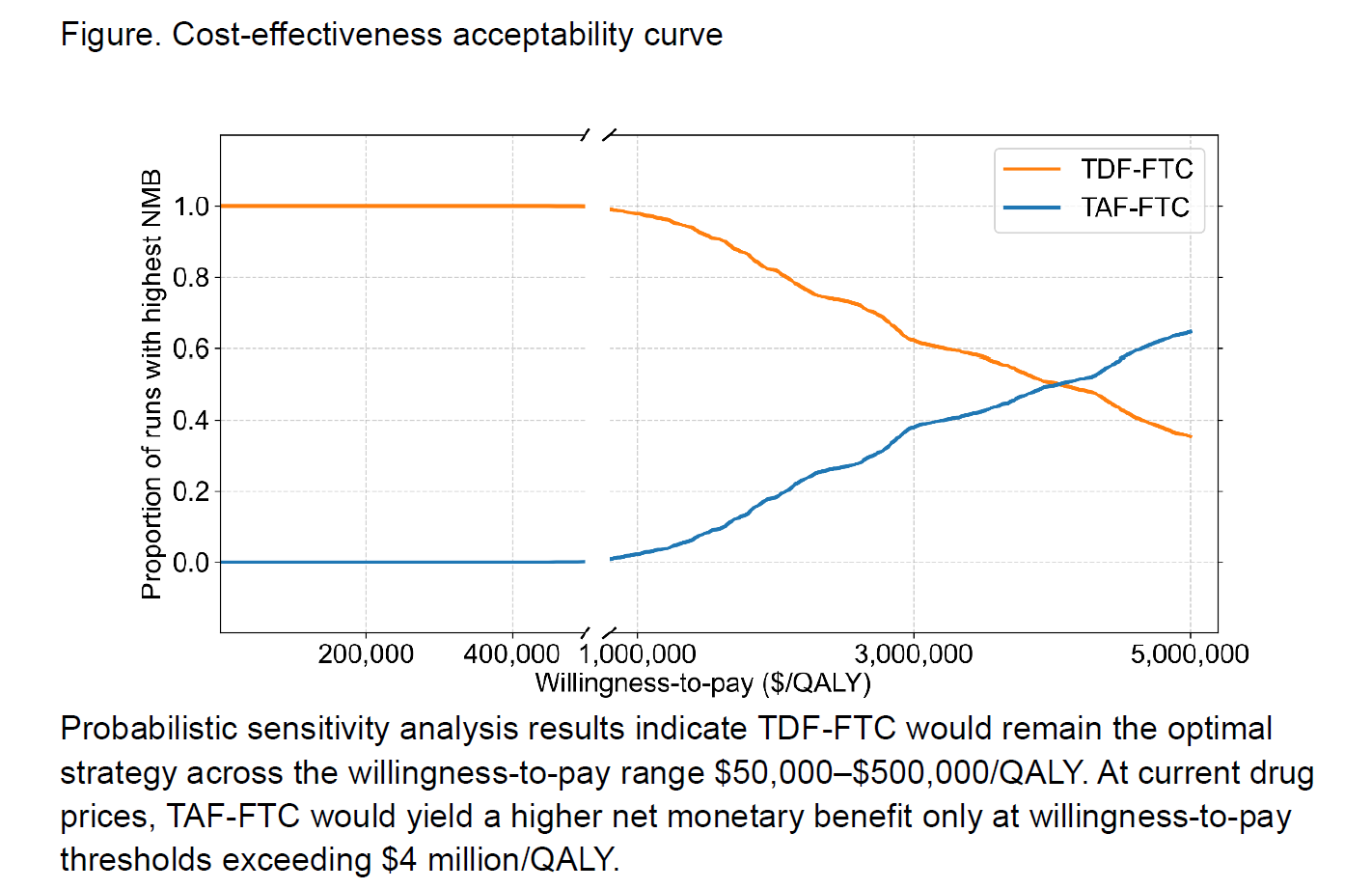
TAF-FTC compared to TDF-FTC would provide more clinical benefit but would cost more and would not be cost-effective (ICER=$3.2 million/QALY). Even if a study eliminated AE uncertainties, at current drug prices, TDF-FTC would always provide a higher NMB, implying VOI equals zero. Improving TDF-FTC uptake among current YMSM on PrEP could yield a 10-year VOM of $7.7 billion. PSAs (Figure) indicate TDF-FTC would remain the optimal strategy (higher NMB). Expanding PrEP use to all YMSM with PrEP indications along with improving TDF-FTC uptake could yield a 10-year VOM of $31.2 billion.
Conclusions
While reducing uncertainty related to PrEP AEs among adolescents would not influence decision-making around the optimal daily oral PrEP strategy for YMSM, improving TDF-FTC uptake for those currently on PrEP could lead to 10-year savings of $7.7 billion.
Table or Figure