Background
People who use drugs (PWUD) remain disproportionally affected by HIV in Canada. Despite its proven effectiveness and availability of long-acting options, HIV pre-exposure prophylaxis (PrEP) uptake among PWUD is low. We evaluated PrEP awareness, and modality preferences among PWUD engaged in care in Vancouver’s Downtown Eastside (DTES).
Methods
We recruited PWUD age 19 and older from 6 addictions and primary care clinics in DTES Vancouver for a cross-sectional knowledge survey. We evaluated proportions of those reporting awareness and willingness to use PrEP, and preference for daily oral PrEP, 2-monthly (Q2M), or 6-monthly (Q6M) injectable PrEP. We performed multivariable logistic regression to assess for factors associated with Q6M preference, adjusted for age, gender, housing status, frequency of drug use, engagement in opioid substitution, sexual risk group, and STI history.
Results
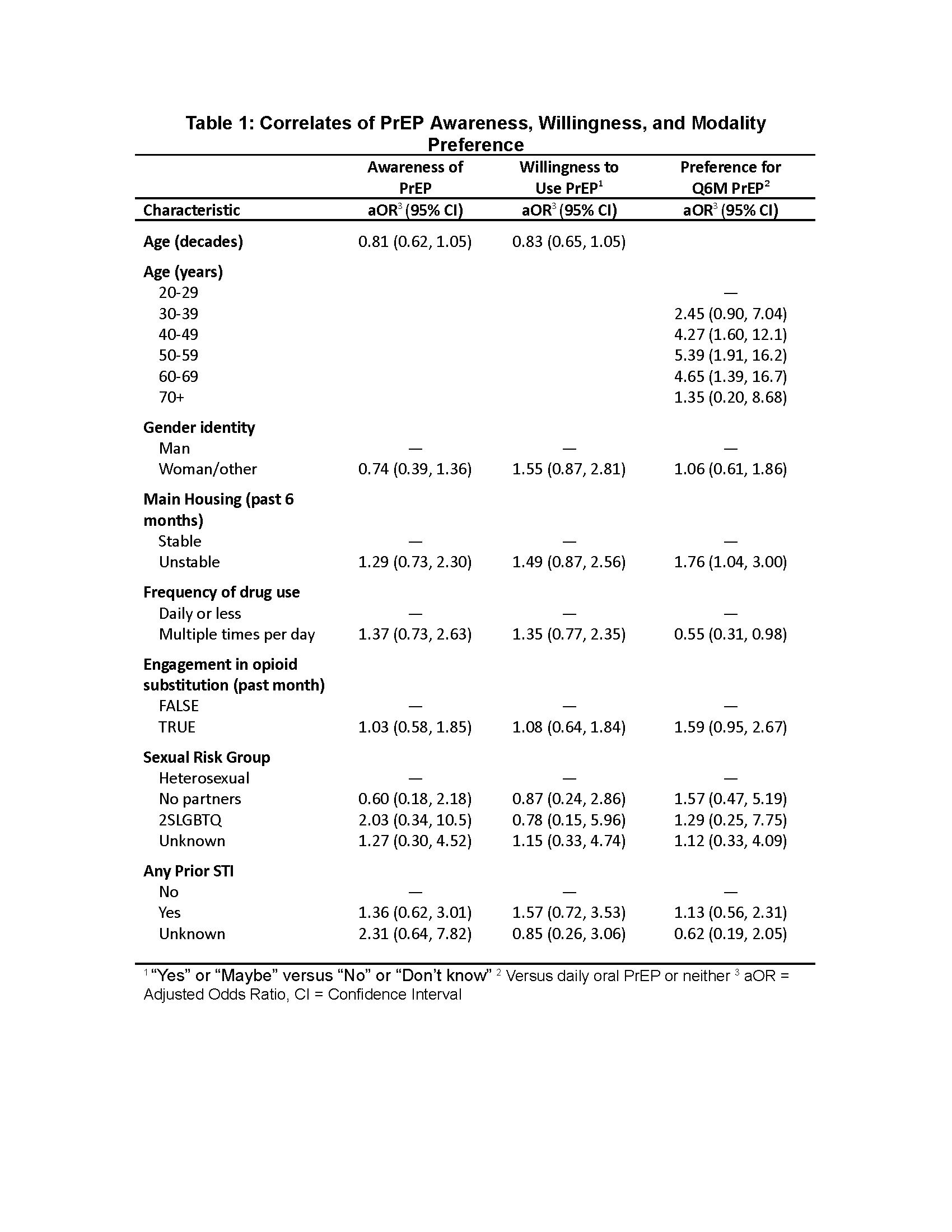
Of 293 participants reporting any drug use in the past 6 months, most were white (53%) or Indigenous (34%), identified as cisgender men (65%), with main source of income being social assistance or pension (89%). Overall 24% (95% CI:19%-29%) of participants reported prior awareness of PrEP, while 67% (62%-73%) reported they would or might be willing to take PrEP. Most participants (62.7% [56.9%-68.3%]) indicated a preference for Q6M PrEP, or Q2M (61.4% [55.6 – 67.0%] while 28% (23%-34%) preferred oral PrEP. No factors were significantly associated with awareness of PrEP. Willingness to use PrEP was associated with lower age (OR 0.7 [0.56-0.87] per 10 year increase), non-male gender identity (OR 1.89 [1.11-3.30]), unstable housing (OR 1.76 [1.07-2.92]), and reporting using drugs multiple times per day (OR 1.78 [1.07-2.96]) in univariate analysis, but not in the adjusted model (Table 1). Unstable housing (aOR 1.76 [1.04-3.00]) was predictive of stronger preference for Q6M PrEP, while reporting using drugs multiple times per day were predictive of preference for oral PrEP (aOR 0.55 [0.31-0.98]).
Conclusions
Overall prior PrEP awareness amongst PWUD engaged in care was low, while willingness to use injectable modalities was high. Findings suggest that in order to maximize uptake, messaging about injectables should be tailored towards those with unstable housing while messaging about oral PrEP may resonate best with those with more frequent drug use.
Table or Figure