Background
To ensure the safety of PrEP use, CDC recommends testing all PrEP users for HIV and sexually transmitted infections (STIs) at PrEP initiation and regular intervals during use. CDC also recommends testing oral PrEP users for hepatitis B virus (HBV) at initiation, and creatinine at initiation and during use. Testing users of tenofovir alafenamide and emtricitabine (TAF/FTC) for lipids is recommended at initiation and annually during use.
Methods
We analyzed the MarketScan commercial insurance database and identified persons who initiated oral or CAB-LA PrEP during 2022-2023. We analyzed testing records for HIV antigen/antibody (Ag/Ab), HIV RNA, HBV, STIs, creatinine, and lipids stratified by PrEP type. For each test, we estimated proportions of persons tested at PrEP initiation (±14 days from first prescription), and at follow-up within 90 days after the inferred end of PrEP use. To ensure sufficient time for follow-up, we used denominators based on the recommended interval for each test: HIV Ag/Ab testing was assessed among persons prescribed PrEP ≥3 months; STI testing for those prescribed ≥6 months; creatinine testing for those either aged ≥50 years and prescribed ≥6 months or all users prescribed ≥12 months; and lipid testing for those prescribed TAF/FTC ≥12 months. We calculated the median time and interquartile range (IQR) from PrEP initiation to the first follow-up test.
Results
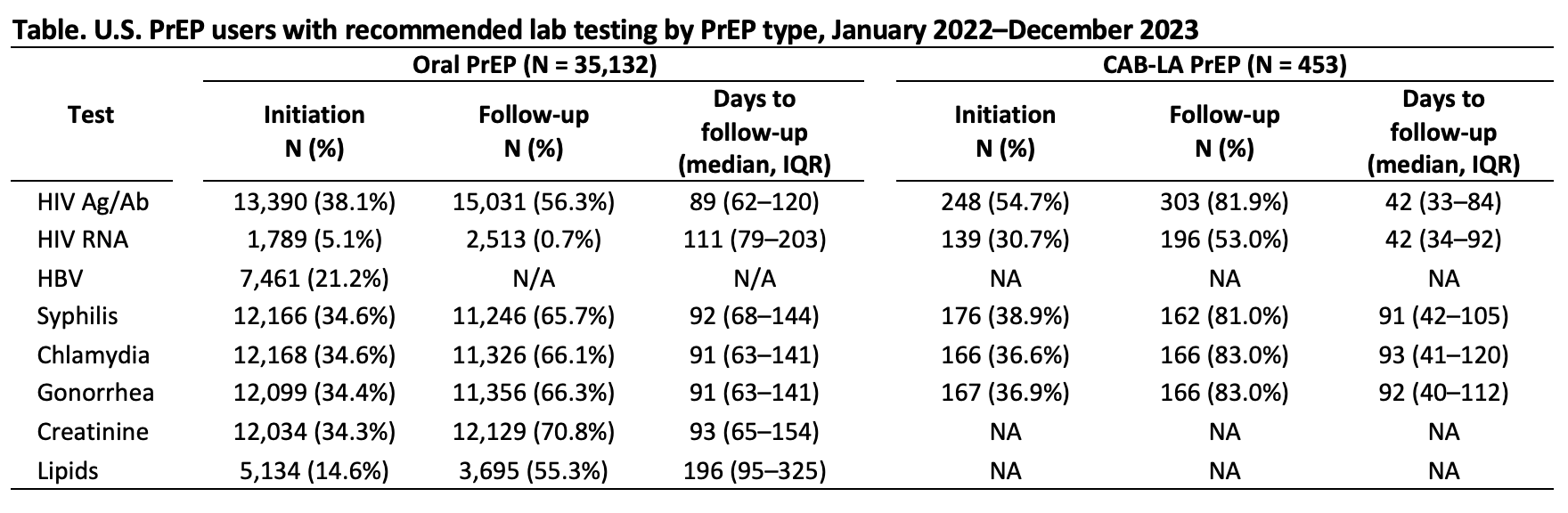
Among 35,132 oral PrEP users, only 38% had an HIV Ag/Ab test at initiation and 56% had a follow-up test while using PrEP (Table). At initiation of oral PrEP, testing rates were 21% for HBV, 35% for syphilis, 35% for chlamydia, 34% for gonorrhea, 34% for creatinine, and 15% for lipids. Among 453 CAB-LA PrEP users, only 55% had an HIV Ag/Ab test and 31% had an HIV RNA test at initiation. At follow-up, 82% of CAB-LA PrEP users had an HIV Ag/Ab test and 53% an HIV RNA test. At initiation of CAB-LA PrEP, 39% had a syphilis test, 37% had a chlamydia test, and 37% had a gonorrhea test.
Conclusions
Lab testing of PrEP users, including HIV testing, was suboptimal and not in accordance with CDC recommendations. PrEP users might have been tested for HIV using only a point-of-care (POC) test to facilitate rapid PrEP initiation despite a recommendation to confirm a negative POC test result with lab-based HIV testing. Implementation of clinical decision supports with automated lab order sets tailored to each type of PrEP medication could increase adherence to recommended PrEP lab testing.
Table or Figure