Background
Nearly 300 million people have chronic hepatitis B infection (HBV), which can result in hepatic complications (e.g., cirrhosis and hepatocellular carcinoma [HCC]) and mortality. Our objective was to develop and validate an HBV simulation model to examine disease progression, treatment, and cure.
Methods
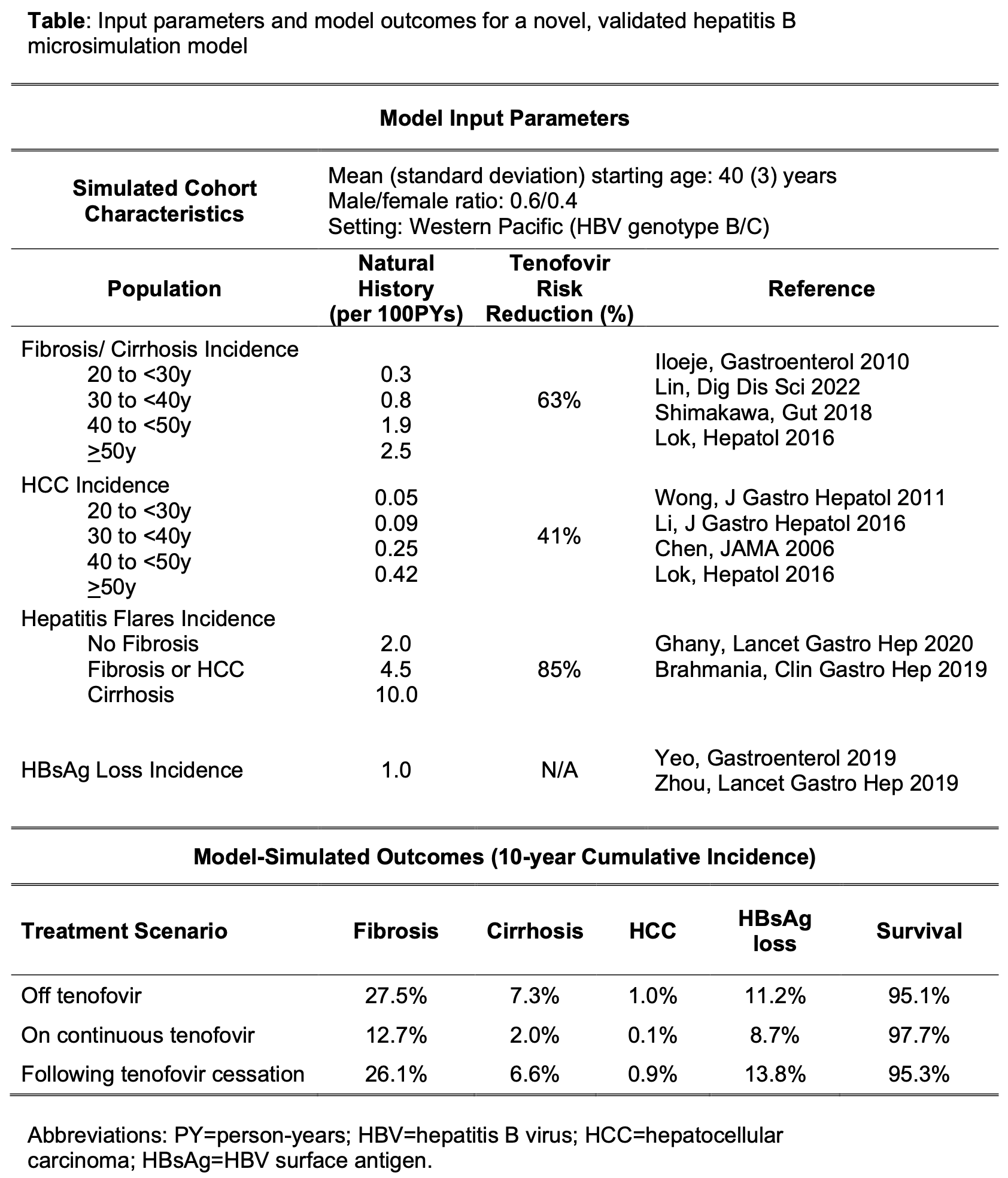
We developed an HBV simulation model with nine health states: HBV-uninfected; no fibrosis; moderate/severe fibrosis; cirrhosis; HCC; end-stage liver disease; hepatitis flare (ALT >3x upper limit of normal); HBV surface antigen (HBsAg) loss; and death. We incorporated anti-HBV effects of tenofovir as lowering incidence of fibrosis, cirrhosis, HCC, and hepatitis flare. Input parameters included: progression to fibrosis or cirrhosis (0.3-2.5/100 person-years [PYs]), incidence of HCC (0.05-0.42/100 PYs), hepatitis flares (2.0-10.0/100 PYs), and functional cure (1.0/100 PYs). We modeled the risk reduction with tenofovir for fibrosis/cirrhosis (0.37), HCC (0.59), and hepatitis flares (0.15). Model outcomes included the cumulative incidence of fibrosis, cirrhosis, HCC, HBsAg loss, and survival. We simulated the benefits of tenofovir therapy and the effects of tenofovir cessation for a cohort with HBV genotype B or C and mean starting age of 40 years. We also validated the model to simulate HCC incidence in a population of African origin.
Results
Consistent with data from the Western Pacific region, 10-year cumulative incidence of fibrosis, cirrhosis, and HCC in untreated HBV would be 27.5%, 7.3%, and 1.0%, respectively. Uninterrupted tenofovir therapy would reduce liver-related complications and improve 10-year survival for an adult cohort with genotype B or C (97.7% v. 95.1% without treatment). After tenofovir cessation, people would have an increased risk of hepatitis flares (53% over 12 months) but a higher rate of HBsAg loss (1.9% at 12 months), consistent with HBV treatment cessation studies. Model validation produced equivalent HCC projections to a published cohort of people of African origin (10-year cumulative incidence 2.33% v. 2.45%, root-mean-square error 0.126).
Conclusions
We developed and validated an HBV simulation model that incorporates the impact of treatment and its cessation on clinical outcomes; when used in conjunction with established HIV models, it can also be used to simulate HIV-HBV coinfection. This model will help to address clinical and policy questions such as HBV cure, the risks and benefits of tenofovir cessation, and pre-exposure HIV prophylaxis.
Table or Figure