Background
Cardiovascular disease is a growing cause of morbidity and mortality in people living with HIV (PLWH). Arterial stiffness may be an intermediary between HIV-infection and CVD, necessitating holistic assessment of arterial stiffness and correlation with cardiac outcomes. We conducted a cross-sectional study of PLWH and HIV-uninfected community controls using multimodal assessment of arterial stiffness and echocardiographic outcomes.
Methods
We performed ankle-brachial index (ABI) and pulse-wave velocity (PWV) to characterize arterial stiffness in a cohort of PLWH and HIV-uninfected community controls in Mwanza, Tanzania. Simultaneous echocardiograms were performed to define cardiac outcomes including left-ventricular mass index (LVMI), left-ventricular hypertrophy, average e’, and average E:e’. Multivariable logistic regression analysis was used to determine differential risk factors for ABI vs PWV and to determine associations between arterial stiffness and echocardiographic outcomes.
Results
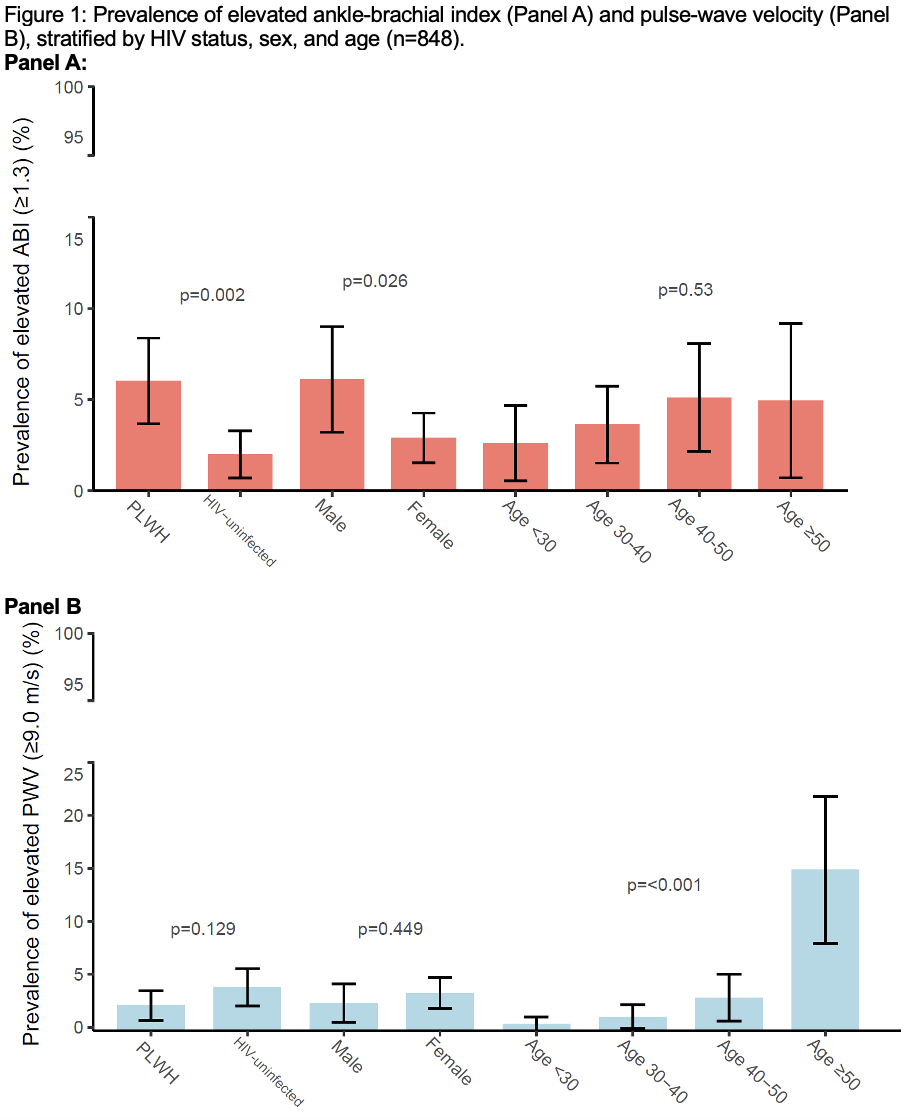
We enrolled 848 participants; 398/848 PLWH (46.9%) and 450/848 community controls (53.1%). Age and sex distributions were similar between the two groups. All PLWH were on anti-retroviral therapy (ART) with a mean treatment duration of 2.46 years (SD 0.92). In multivariable models, elevated ABI was associated with HIV infection (3.26 (1.48, 7.16), p=0.003), male sex (3.09 (1.40, 6.82), p=0.005), and BMI (1.08 (1.01, 1.16), p=0.026), whereas elevated PWV was associated with age (1.11 (1.06, 1.17), p<0.001) and systolic blood pressure (1.64 (1.27, 2.10), p<0.001) (Figure 1). After adjusting for confounders, ABI was associated with LVMI (7.06 (0.23, 13.91), p=0.043) and average E:e’ (0.75 (0.19, 1.31), p=0.009), while PWV was associated with LVMI (10.52 (2.47-18.57), p=0.010). No significant interactions with HIV-status were found between arterial stiffness measures and echocardiographic outcomes.
Conclusions
Differential associations between HIV and multiple measures of arterial stiffness suggest that HIV is associated with peripheral but not central arterial stiffness. Arterial stiffness was correlated with cardiac hypertrophy and impaired cardiac filling, suggesting a mechanistic pathway for HIV-related CVD that includes peripheral arterial stiffness. Young, male PLWH in similar settings are at risk for sub-clinical and undetected vascular aging.
Table or Figure