Background
Development of neurocognitive disorders (ND) remains a concern among persons with HIV (PWH), despite advances in antiretroviral treatments (ART) which have aided in reducing ND incidence. Studies have indicated increased risk for ND among PWH with comorbidities such as obesity, cardiovascular disease (CVD), Hepatitis C, and toxoplasmosis. The purpose of this analysis was to determine the incidence, trends, and comorbidities associated with electronic health record (EHR)-based documented NDs among a longitudinal cohort of PWH in Washington, DC.
Methods
Using EHR data from the DC Cohort, an ongoing longitudinal study of PWH in Washington, DC, from 1/12/11 through 6/30/24, we identified PWH with ICD codes indicative of NDs, classified as mild (e.g., mild cognitive impairment, delirium) or advanced (e.g., dementia, neurogenerative disorder), and medical comorbidities. We conducted bivariable analyses comparing those with and without ND. We calculated temporal trends for ND. Logistic regression analyses examined associations between ND and pre-diagnosis comorbidities, adjusting for demographic (e.g., age), socioeconomic, and HIV-related factors. ART utilization prior to ND diagnosis was also explored.
Results
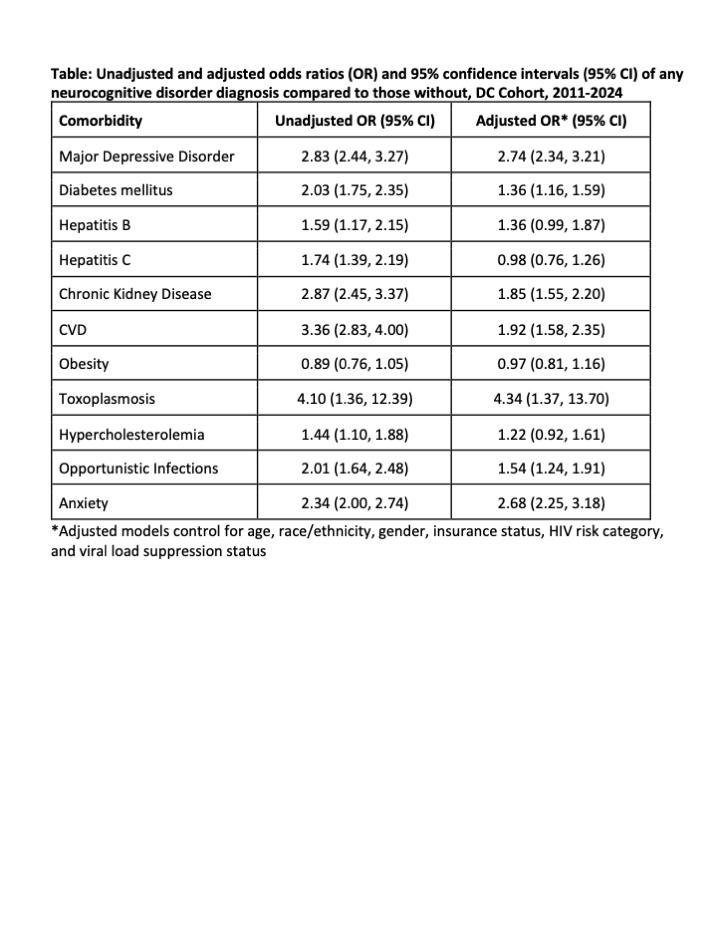
There were 796 unique cases (6.1%) of ND identified (157 mild and 732 advanced). Differences in ND cases vs. non-cases were found by age (57 vs. 46, p<0.01), race/ethnicity (non-Hispanic white=15.6% vs 12.7%, p<0.01), insurance status (private=23.1% vs. 30.7%, p<0.01), and viral load (not suppressed <200 copies/mL=17.8% vs. 21.0%; p<0.05). Incidence decreased slightly for mild ND and increased for advanced (p<0.001) over the study period. Pre-ND diagnoses of DM and CVD were highly prevalent for both mild ND (40.3%, 67.5%, respectively) and advanced ND (29.1%, 56.6%). In adjusted logistic regression models, PWH with ND were more likely to have major depressive disorder (MDD), diabetes mellitus, CVD, chronic kidney disease, toxoplasmosis, opportunistic infections, and anxiety (Table). Of those with available ART data prior to ND diagnosis, the greatest prevalence of utilization was INSTI-based (32.9%), Dual class (22.8%), and PI-based (22.1%) ART.
Conclusions
While the prevalence of PWH with ND in our analysis was low, the incidence of advanced ND is increasing. PWH with ND were more likely to have several comorbidities, indicating increased burden of disease. Identification of prevalent pre-ND disorders may help elucidate ND development among aging PWH.
Table or Figure