Background
Understanding the impact of gender-affirming hormone therapy (GAHT) on immune regulation in transgender women living with HIV (TWH) is essential for improving HIV care and developing cure strategies.
Methods
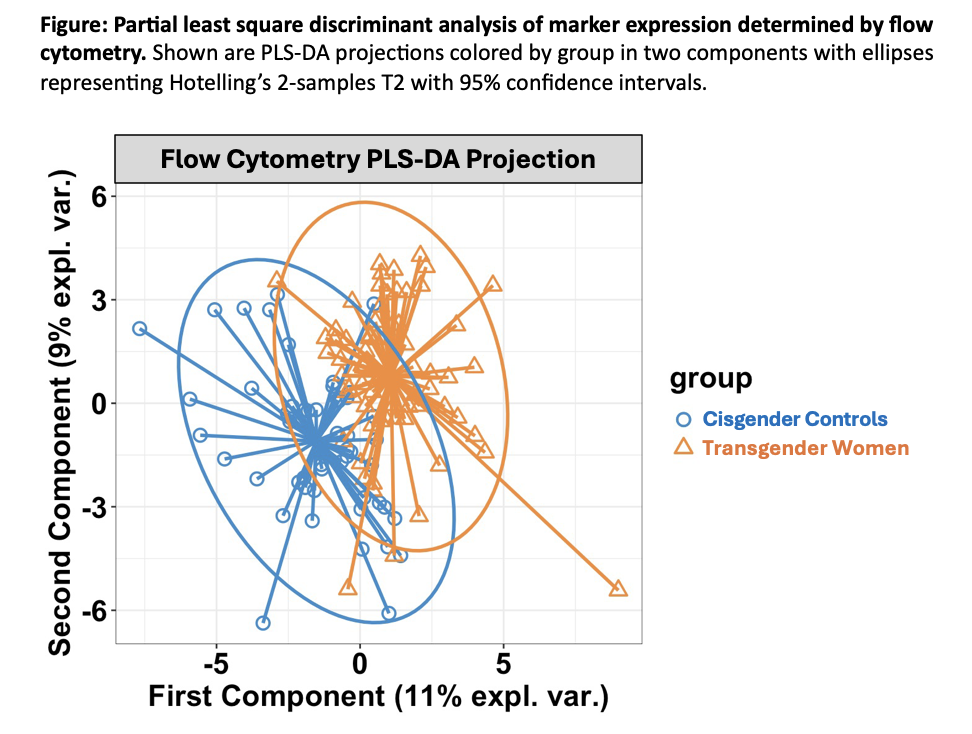
TWH on suppressive ART initiating estradiol-based GAHT were recruited from HIV clinics in San Diego, CA, and Houston, TX. Blood samples were collected before and longitudinally 2, 4, 6, 9, 12, and 18-months post GAHT initiation. Historical samples from cisgender men with HIV were matched by age, CD4+ T cell count, duration of HIV and time on ART. Flow cytometry assessed markers of T cell activation (HLA-DR+CD38+), cytotoxicity (CD107a+), proliferation (Ki67+), and exhaustion (TIGIT+PD-1+) in CD4+ and CD8+ memory subsets. A partial least squares-discriminant analysis (PLS-DA) distinguished between transgender and cisgender groups using all flow cytometry features. Post-hoc analysis with generalized mixed-effects models examined markers with variable importance for projection (VIP) ≥ 1, adjusting p-values for multiple comparisons using the false discovery rate method.
Results
A total of 22 TWH were enrolled. Nine were lost of follow-up including one suicide, one homicide, and two imprisonments. 75 samples from TWH and 53 samples from 13 historical cisgender controls were analyzed. The PLS-DA model accurately predicted gender groups with an error rate of 17.2% (Figure). Four T cell phenotypes were significantly different between groups in post-hoc analysis: TWH had more cycling (Ki67+) effector memory and terminally differentiated CD8+ T cells (p=0.015, incidence rate ratio (IRR)=2.31 and p=0.021, IRR=2.16, respectively) but fewer exhausted (expressing TIGIT+) effector CD8+ T cells (p=0.027, IRR=0.45). TWH also had a significantly higher proportion of naïve CD8+ T cells (p=0.027, IRR=2.03). There were no significant differences in T cell phenotypes over time.
Conclusions
Immunophenotypic analysis of TWH compared to historical cisgender male controls revealed differences in the CD8⁺ T cell compartment, including increased cell cycling and lower TIGIT expression. Prior studies have shown disparities in activation and exhaustion markers (e.g., PD-1) between cisgender men and women living with HIV. Our findings indicate a unique immune profile for TGW, potentially influenced by chronic immune activation, pre-existing variations in TWH, or hormonal factors. Further investigation will determine underlying mechanisms and their relationship with virologic outcomes.
Table or Figure