Background
Cognitive impairment remains a crucial health issue among people with HIV (PWH). However, the course of cognitive impairment has shifted considerably since the introduction of combined antiretroviral therapy. We aimed to determine the differences in cognitive decline between PWH with and without cognitive impairment at baseline in a cohort of virologically suppressed older PWH.
Methods
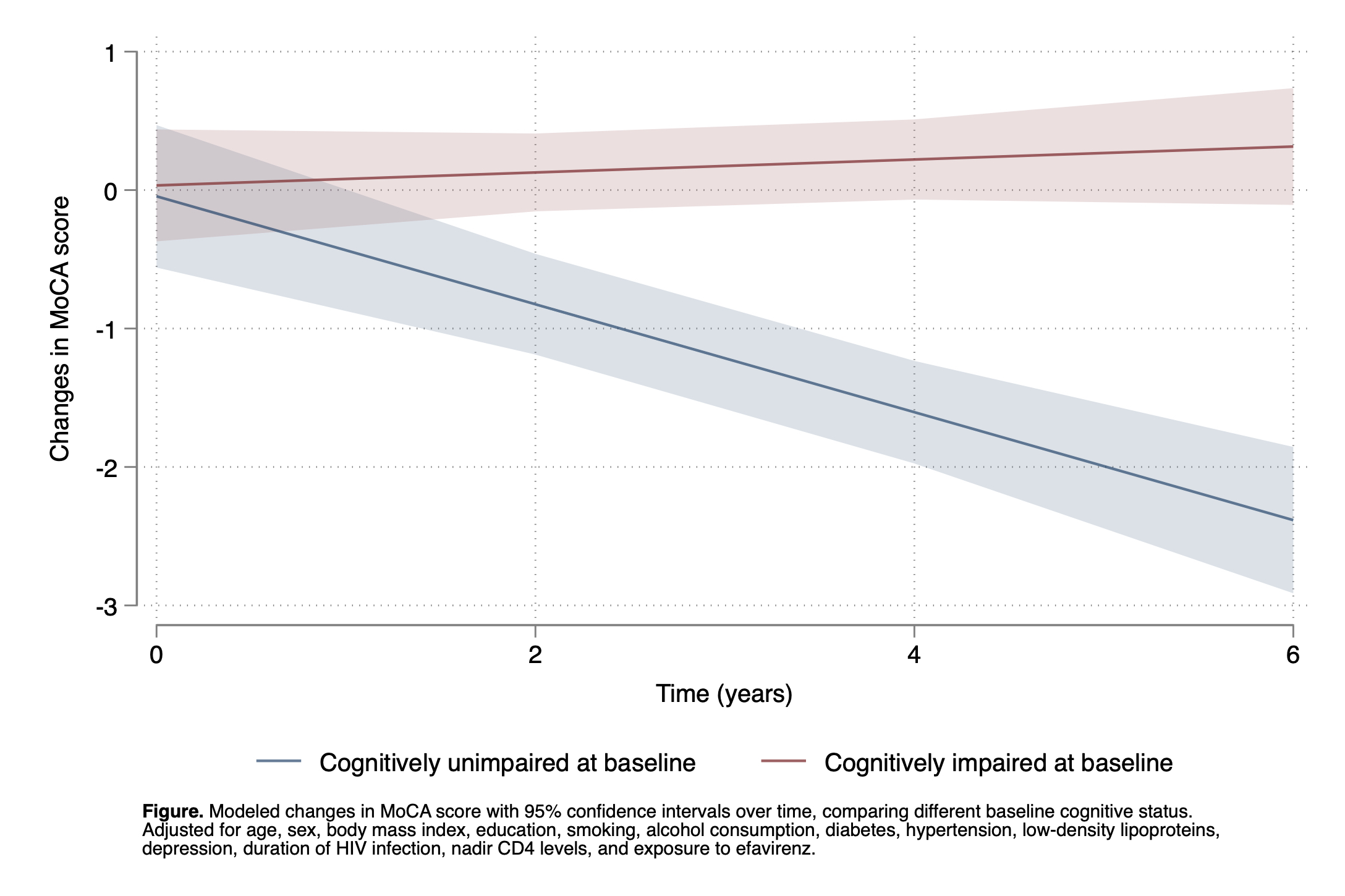
Virologically suppressed Thai PWH aged 50 years or older were enrolled between 2015 and 2017. Cognitive performance was assessed at enrollment using the Thai-validated Montreal Cognitive Assessment (MoCA), with a score of <25 indicating cognitive impairment. Follow-up MoCA assessments began in 2021. A multivariate linear mixed-effects model, with an interaction term between baseline cognitive status and follow-up time, was used to estimate differences in cognitive performance changes over time between those who were cognitively impaired and unimpaired at baseline.
Results
Among 287 PWH included (38.0% female, median age 54.5 [IQR: 52.0–59.4] years, 25.4% with six years or less education, median HIV duration of 18.1 [IQR: 14.9–20.9] years), 61.3% had cognitive impairment at baseline. PWH with baseline cognitive impairment were significantly older, more likely to be female, and had less education. The median interval between the two MoCA was 5.9 (IQR: 5.6–6.8). After adjusting for age, sex, body mass index, education, smoking, alcohol consumption, diabetes, hypertension, low-density lipoproteins, depression, HIV duration, nadir CD4 levels, and exposure to efavirenz, cognitively unimpaired PWH at baseline showed a greater decline in cognitive performance compared to those with baseline cognitive impairment, with a difference in MoCA score of -2.4 (95%CI -2.9 to -1.9) for the cognitively unimpaired group, compared to +0.3 (95%CI -0.1 to 0.7) for the cognitively impaired group over 6 years (P-interaction<0.001) (Figure). Notably, delayed recall was the only MoCA subdomain where the cognitive trajectory differed significantly between the two groups (P-interaction<0.001).
Conclusions
Despite initially better cognitive performance, virologically suppressed older Thai adults with HIV who were cognitively unimpaired at baseline showed greater cognitive decline compared to those with baseline cognitive impairment. Investigating the potential role of dynamic lifestyle factors and underlying causes of cognitive impairment could help explain these unexpected findings.
Table or Figure