Background
People with advanced HIV disease (AHD) remain at high risk for opportunistic infections, hospitalization, and death, despite improved access to antiretroviral therapy (ART). We aimed to evaluate the predictive value of serum C-reactive protein (CRP) for the detection of future hospitalization or death among outpatients with AHD in Uganda.
Methods
Serum CRP values were collected prospectively from 759 participants enrolled in the ENCORE trial (NCT05085171), a community-based cluster randomized trial in adults with AHD (baseline CD4 <200 cells/µL). Participants were recruited from May 5, 2022 to February 8, 2024 at outpatient clinics in the Kampala and Wakiso districts of Uganda. We examined baseline CRP as both a continuous predictor and as a dichotomized predictor at a threshold of 10mg/L. We used logistic regression and Cox regression models to assess CRP as a risk factor for hospitalization or death. We calculated the area under the receiver operating characteristic curve (AUC) to evaluate CRP as an independent predictor for 30-day hospitalization-free survival.
Results
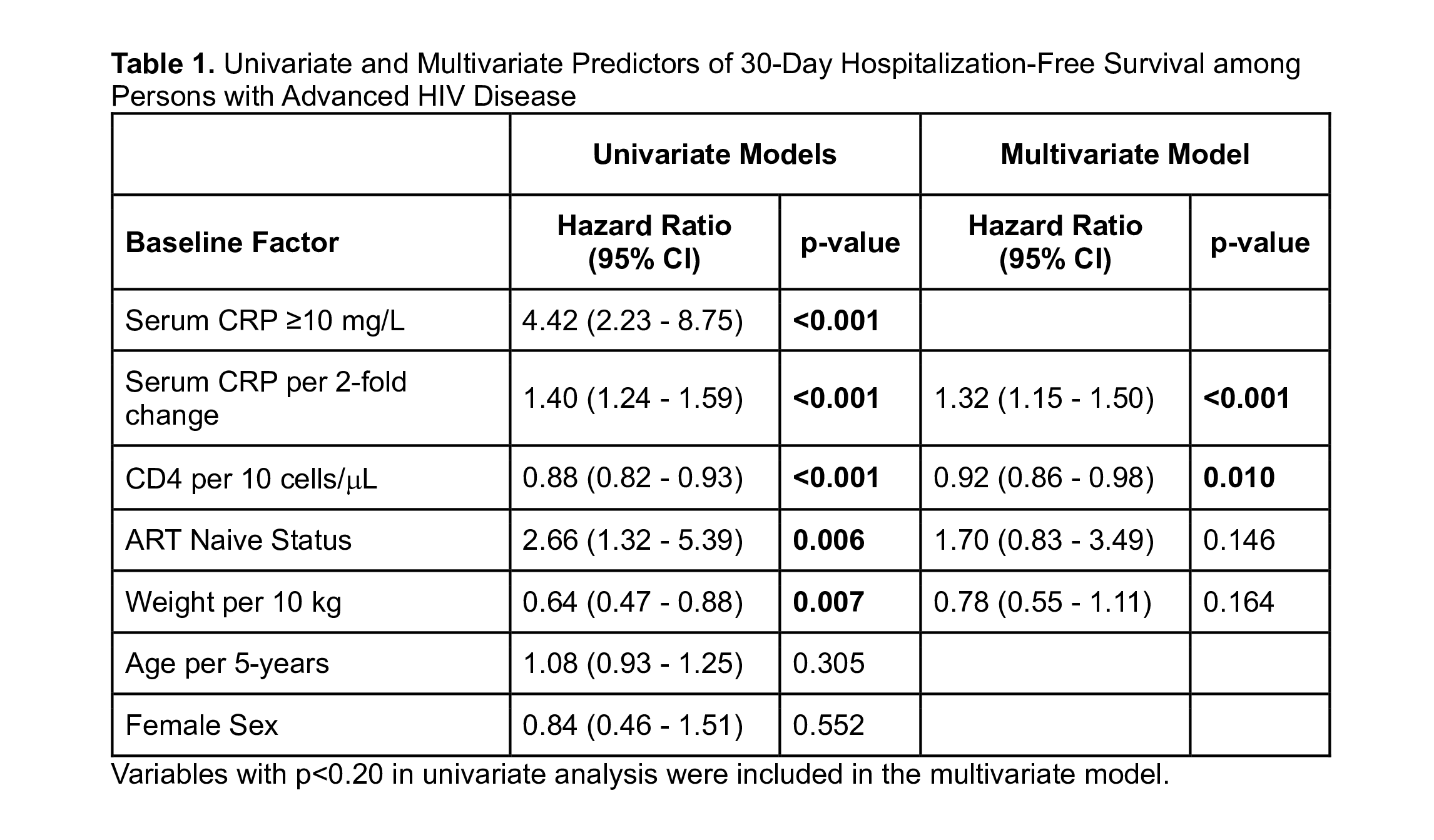
A CRP threshold of 10 mg/L was identified as a strong predictor of 30-day hospitalization or death. In our cohort, 41% had an elevated CRP value (>10mg/L). Participants with elevated CRP were significantly more likely to be hospitalized (Relative Risk=3.18, p=0.002) or die (Relative Risk=8.60, p<0.001) within 30 days of enrollment. When controlling for potential confounding variables of sex, age, weight, CD4 count, and ART status in a multivariate Cox proportional hazards model, the hazard of hospitalization or death within 30 days increased by 32% (HR=1.32, p<0.001) for each doubling of CRP (Table 1). When examining the composite outcome of 30-day mortality or hospitalization, CRP has an AUC of 0.76 as a univariate continuous predictor, and the multivariate model performed significantly better when CRP was included (AUC=0.80), compared to when CRP was excluded from the model (AUC=0.73).
Conclusions
High CRP values are associated with increased risk of hospitalization and/or death within 30 days among outpatients with AHD. Prospective evaluation of point-of-care CRP testing and whether real-time measurements can be used to risk stratify populations for interventions to reduce deaths is needed.
Table or Figure