Background
Children who are born HIV-exposed but uninfected (HEU) are the fastest growing HIV-affected population, numbering at over 16 million children globally.There is a large gap in our understanding of how in utero exposure to HIV and antiretrovirals influence the development and long-term health of these children. A mouse HIV pregnancy model would greatly facilitate such research.
EcoHIV is a chimeric ecotropic HIV virus that has been modified to express the envelope coding region from the murine leukemia virus gp80 instead of gp120 to allow HIV infection in mouse immune cells. EcoHIV infection parallels several major characteristics of HIV in humans including susceptibility to antiretrovirals, induction of anti-viral immune responses, and elevation of inflammatory markers. EcoHIV has not been used in the context of pregnancy before. Here we present a new EcoHIV infection model in a mouse pregnancy model.
Methods
7-week-old C57BL/6 mice were intraperitoneally injected with 2.5×10⁶ pg EcoHIV virus or mock infected with 500uL PBS, and were mated 1 week post infection. Pregnant dams were euthanized on gestational day (GD) 14.5 or 18.5 (N=5/group). Tissue and blood were collected to detect infection through HIV gag expression by qPCR. Fetal and placenta weights, fetal viability and number of resorptions were recorded. mRNA expression of neuroinflammatory markers were assessed in fetal brains (N=24/group) by qPCR. Mann-Whitney test was used for statistical comparisons.
Results
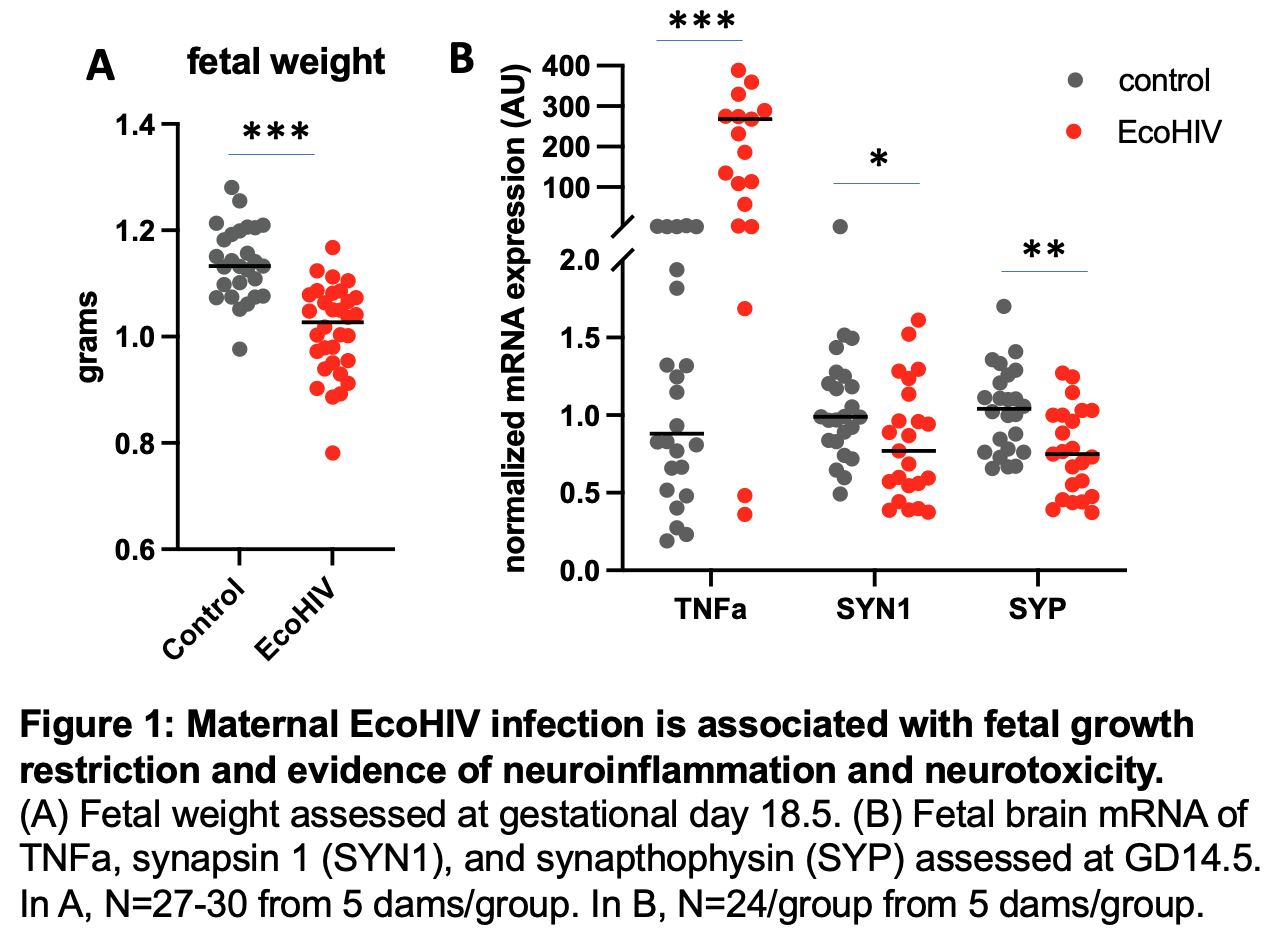
Injection with EcoHIV resulted in 100% maternal infection, confirmed by HIV gag detection in spleen tissue of all dams. No infection was detected in EcoHIV exposed fetuses. EcoHIV infection was associated with significantly lower fetal weights (Figure), lower placenta efficiency, and lower viability rates. TNFa mRNA levels were increased, and mRNA levels of synapsin 1 (SYN1) and synaptophysin (SYP), which are markers of neuronal health, were decreased in brains of EcoHIV exposed fetuses compared to controls (Figure).
Conclusions
The EcoHIV pregnancy model represents the first mouse pregnancy model that includes HIV. In utero EcoHIV exposure was associated with fetal growth restriction and placental insufficiency even in the absence of fetal infection, paralleling clinical findings. Neuroinflammation and neuronal toxicity in EcoHIV exposed uninfected fetuses, may represent a mechanism contributing to neurodevelopmental deficits seen in children who are HEU.
Table or Figure