Background:
Long-acting injectable PrEP (LA-PrEP) and ART (LA-ART) hold significant potential to overcome challenges of daily adherence to oral modalities. Their population-level impact requires acceptability and uptake by populations with the most need, such as people who inject drugs (PWID) and men who have sex with men (MSM) in low/middle income settings.
Methods:
We used respondent-driven sampling to accrue samples of PWID and MSM in India Nov 2022-Aug 2023 (3 PWID sites; 2 MSM sites; ~750/site). Participants were ≥18 years old and reported injection drug use in the prior 2 years (PWID) or sex with a man in the prior year (MSM). Participants completed a survey and blood draw. Those reporting a prior HIV diagnosis were asked questions about LA-ART and those without a prior diagnosis were asked about LA-PrEP. We present acceptability and correlates of LA-PrEP and LA-ART using multilevel logistic regression models by modality and population separately.
Results:
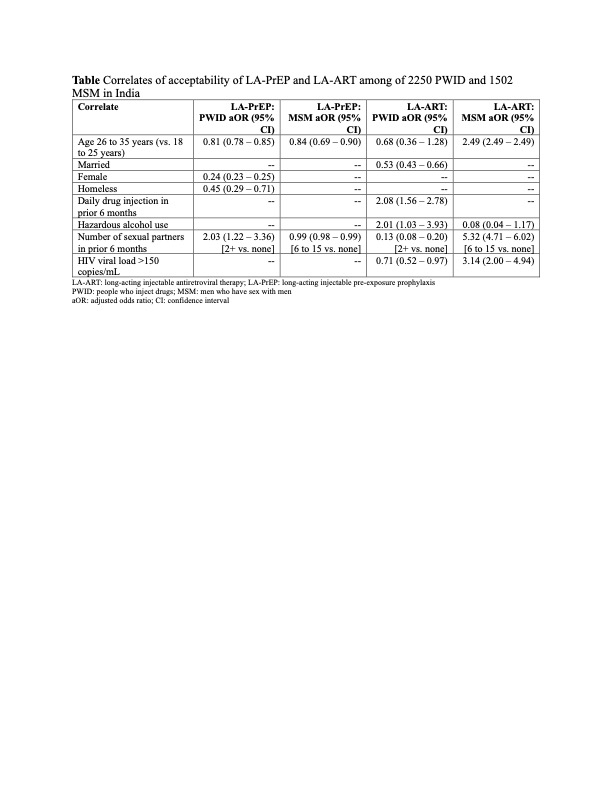
2250 PWID and 1502 MSM were enrolled. PWID HIV prevalence was 41%, of whom 45% were on ART and 34% suppressed (≤150 copies/mL). MSM HIV prevalence was 21%, of whom 65% were on ART and 75% suppressed. Of those not reporting a prior HIV diagnosis, 10/14% (PWID/MSM, respectively) reported no/very little chance they would be willing to get injections to prevent HIV and 65/78% a very good chance. Main reasons for LA-PrEP unwillingness among PWID were inconvenience of injections and low risk perception; among MSM, reasons were injection pain and cost. Among PWID, women and those homeless were less willing to take LA-PrEP and those with more sexual partners were more willing; injection behaviors were not associated (Table). Among MSM, those with more partners were less willing to take LA-PrEP; unprotected sex was not associated. Of those with a prior HIV diagnosis, 3/2% (PWID/MSM, respectively) reported no/very little chance they would willing to take LA-ART and 83/89% reported a very good chance. Among PWID, those injecting daily were more willing to take LA-ART but those viremic were less likely. Among MSM, those with more partners and viremic were more willing. ART use was not associated with LA-ART willingness for either population.
Conclusions:
There was high interest in using LA-PrEP and LA-ART among populations that experience a disproportionate HIV burden and barriers to HIV treatment engagement. However, there remain vulnerable subgroups for which these may not be appropriate and other prevention and treatment approaches will be required.