Background:
Injectable depot medroxyprogesterone acetate (DMPA) is the most common contraceptive choice among young women in Uganda and nearby countries, where HIV burden is also high and HIV PrEP may be offered. DMPA and TDF-based PrEP have been associated with reductions in bone mineral density (BMD) when used consistently over multiple years. For young women who have not yet reached peak bone mass and choose to use DMPA, it is unknown whether concurrent PrEP use exacerbates declines in BMD.
Methods:
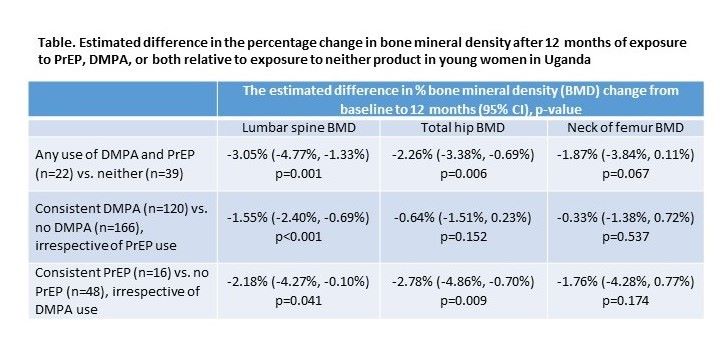
We conducted a 2-year prospective observational study with women ages 16-25 years in Kampala, Uganda, who desired prevention for pregnancy and HIV. Women were provided either condoms or injectable DMPA for contraception and either condoms or FTC/TDF as oral PrEP for HIV prevention, according to their choices. Annual dual x-ray absorptiometry (DXA) scans were performed to measure BMD. We used tenofovir-diphosphate (TFV-DP) quantification in dried blood spots and delivery of DMPA injections to determine exposure to each agent. Linear regression models estimated the difference in % BMD change from baseline to month 12 for women using oral PrEP and DMPA versus women using either agent individually or neither agent.
Results:
Of 499 enrolled women with median age 20 years (IQR 18-21) and normal baseline distribution of BMD z-scores, discontinuation and re-starting of contraceptive and PrEP use was common during follow-up. Women using neither agent (n=39) experienced BMD growth of 2.01% at lumbar spine, 1.22% at hip, 0.10% at femoral neck. Women with consistent use of both agents during 1 year (n=22) experienced an average BMD loss of 1.04% in the lumbar spine and hip and 1.77% in femoral neck. These losses were statistically different relative to women who used neither agent: difference in % BMD change of -3.05% at the lumbar spine (95% CI -4.77%, -1.33%, p=0.001), -2.26% in total hip (95% CI -3.38%, -0.69%, p=0.006), and approached significance at the femoral neck (-1.87%, -3.84%, 0.11%, p=0.067). When examining exposure to each agent independent of the other (Table), we observed some significant declines but in smaller magnitude.
Conclusions:
Despite limited sample size, we observed a trend for women with concurrent DMPA and PrEP use to have 1-3% lower BMD than unexposed women after 12 months. Given participant ages and exposure time, this difference may be clinically significant and further work is need to quantify the impact of longer concurrent exposure to TDF-based PrEP and DMPA.