Background:
Wastewater-based epidemiology (WBE) is being used to identify and quantify infectious agents circulating in communities without the need to test individuals. HIV has previously been detected in wastewater and HIV RNA and DNA have both been amplified from urine and feces of people living with HIV (PLWH). Thus, measuring HIV in wastewater appears feasible, but has not been used for the purpose of monitoring HIV in communities.
Methods:
We applied a previously developed hydrolysis-probe based PCR assay targeting the LTR region of HIV-1 to quantify nucleic acids (NA) in wastewater settled solids using droplet digital (RT-)PCR. We performed retrospective monitoring of HIV-1 concentration in longitudinal wastewater samples from two publicly owned wastewater treatment plants, one in San Francisco (OSP) and the other in San Jose (SJ) between February 2021 and April 2023. Samples were collected two times per week. To assess concordance between wastewater data and local surveillance data from public health departments, we compared trends in wastewater HIV-1 concentrations to HIV prevalence estimates per county.
Results:
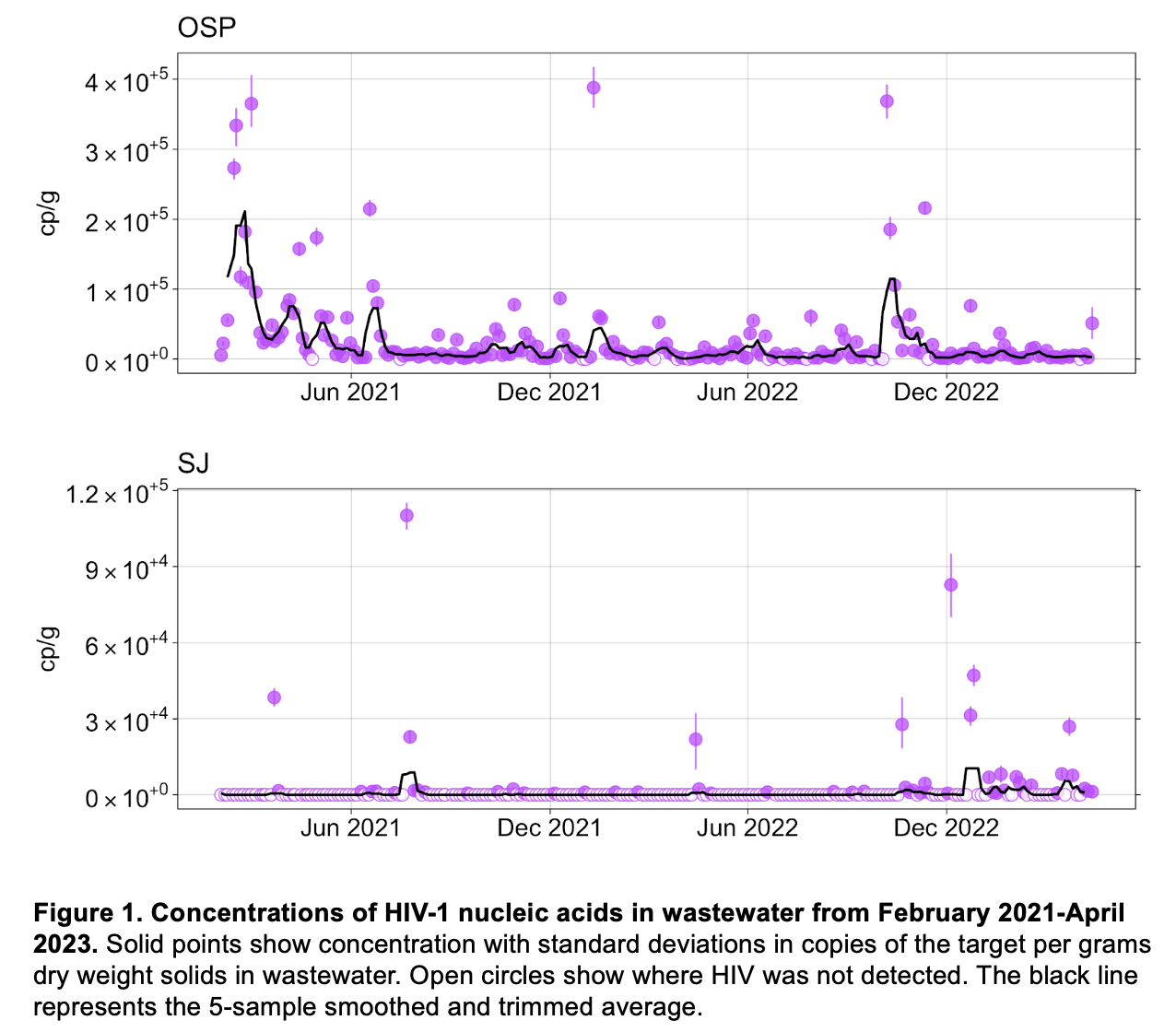
Highly abundant HIV-1 NA were detected in 94% (215/230) and 23% (53/229) of samples in OSP and SJ sewersheds, respectively. Samples from the OSP sewershed consistently yielded higher concentrations of HIV NA than samples from SJ (OSP median 7.3*10^3 cp/g [range non-detect to 3.9*10^5 cp/g], SJ median non-detect [range non-detect to 1.1*10^5 cp/g], figure 1) mirroring surveillance estimates of higher community prevalence of HIV in San Francisco County than in Santa Clara County in 2021 (1334.1 and 190.6 PLWH per 100,000 population, respectively). We observed similar concentrations of HIV-1 NA in analyses with and without a reverse transcription step during PCR suggesting that most, if not all, of measured NA in wastewater is HIV-1 DNA rather than RNA.
Conclusions:
Our findings demonstrate the feasibility of monitoring HIV concentrations in communal wastewater and show good concordance with local surveillance data on HIV prevalence. Results from wastewater can be used to obtain information on HIV at a localized, community level and could serve as a complementary approach to existing HIV surveillance frameworks helping identify priority areas for intervention. Further work by our group will investigate dynamics of viral shedding in PLWH, develop assays for measuring antiretroviral drug-resistance in wastewater, and identify the optimal uses of wastewater surveillance of HIV-1.