Background:
Life expectancy (LE) of people with HIV (PWH) has risen considerably in the last decades, but LE gains among females with HIV have fallen behind.
Methods:
We examined trends and sex differences in LE and mortality among all PWH in British Columbia (BC), using data from the Comparative Outcomes And Service Utilization Trends study. LE at ages 20, 40, and 55 was calculated using life tables stratified by sex and period (1996-2002, 2002-12, 2012-20). Using multivariable Cox regression, we modelled the association between female sex and all-cause mortality, adjusted for age and baseline confounders: history of injection drug use, residence in Vancouver’s Downtown Eastside area, residence in a rural area, area-level income. Secondly, models were adjusted for CD4 count at antiretroviral therapy (ART) initiation. Models were repeated for each period and for mortality from communicable disease, non-communicable disease, and injuries/external causes (defined using ICD codes).
Results:
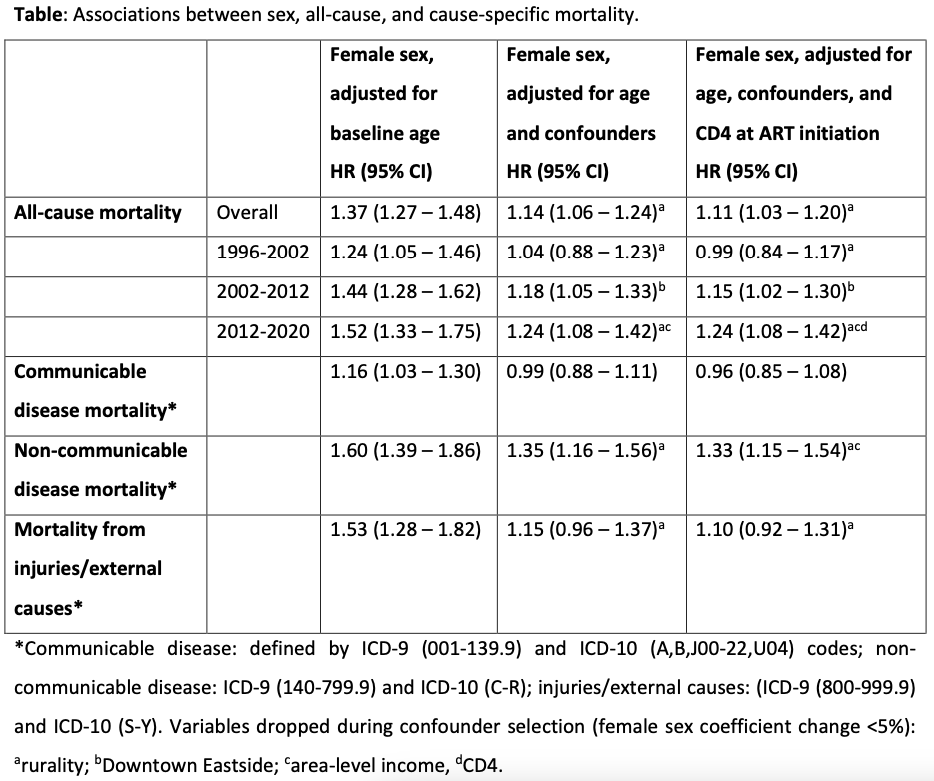
A total of 11,739 males (82%) and 2,534 females (18%) with HIV were included; 92% and 88%, respectively, were ever on ART. LE for males aged 20 increased from 24.5 (95% CI 22.3–26.6) in 1996-2002 to 37.1 (35.4–38.8) in 2002-12, and to 48.0 (45.7–50.3) in 2012-20. LE for females aged 20 increased, but remained lower, from 22.1 (19.9–24.4), to 32.8 (30.6–34.9), and to 40.9 (37.7–44.2). Patterns were similar at age 40 and 55. The sex gap in LE increased over time, both at age 20 and 40 (from 3.2 in 1996-2002 to 5.3 years in 2012-20), but was not as discernible at age 55. In adjusted models, female sex was significantly associated with all-cause mortality, overall and in 2002-12 and 2012-20 (Table). Similarly, in adjusted models, female sex was associated with mortality from non-communicable disease, but not from injuries/external causes and communicable disease. Further adjustment for CD4 count at ART initiation did not affect the associations significantly.
Conclusions:
In a setting with universal health care and free ART, the sex gap in LE among PWH continues to increase with time. Clinical and socio-economic factors do not explain that this gap in LE and HRs are increasing over time, but they do largely explain differences in mortality from communicable disease and injuries/external causes. If PWH followed the pattern observed among people without HIV in BC, we would expect the gap in LE to favor females. Our work suggests that addressing socio-structural factors may potentially reduce but not reverse the gap.