Background:
Dyslipidemia is common in persons with HIV (PWH) and mechanistically linked to the development of metabolic disease. Higher plasma triacylglycerides (TG) are associated with the diabetes, while an inverse relationship is observed for sphingomyelin (SM) and phosphatidylcholine (PC) species. Adipose tissue has a critical role in regulating lipid homeostasis, but how adipose tissue cellular composition might influence circulating lipid classes in PWH is unknown. We hypothesized that greater pro-inflammatory macrophage and pro-fibrotic stromal cells in subcutaneous adipose tissue (SAT) are associated with higher circulating TG and lower SM and PC species.
Methods:
We performed single-cell RNA sequencing on SAT biopsies from PWH on contemporary antiretroviral therapy with virologic suppression and a range of metabolic fitness. We characterized SAT cell types except adipocytes, which are poorly captured with this method. We simultaneously performed untargeted lipidomic liquid chromatography-high resolution tandem mass spectrometry on plasma samples. We assessed the relationship of cell composition with normalized summed-lipid class intensities with partial Spearman’s adjusted for statin use, sex, body mass index (BMI) and diabetes status.
Results:
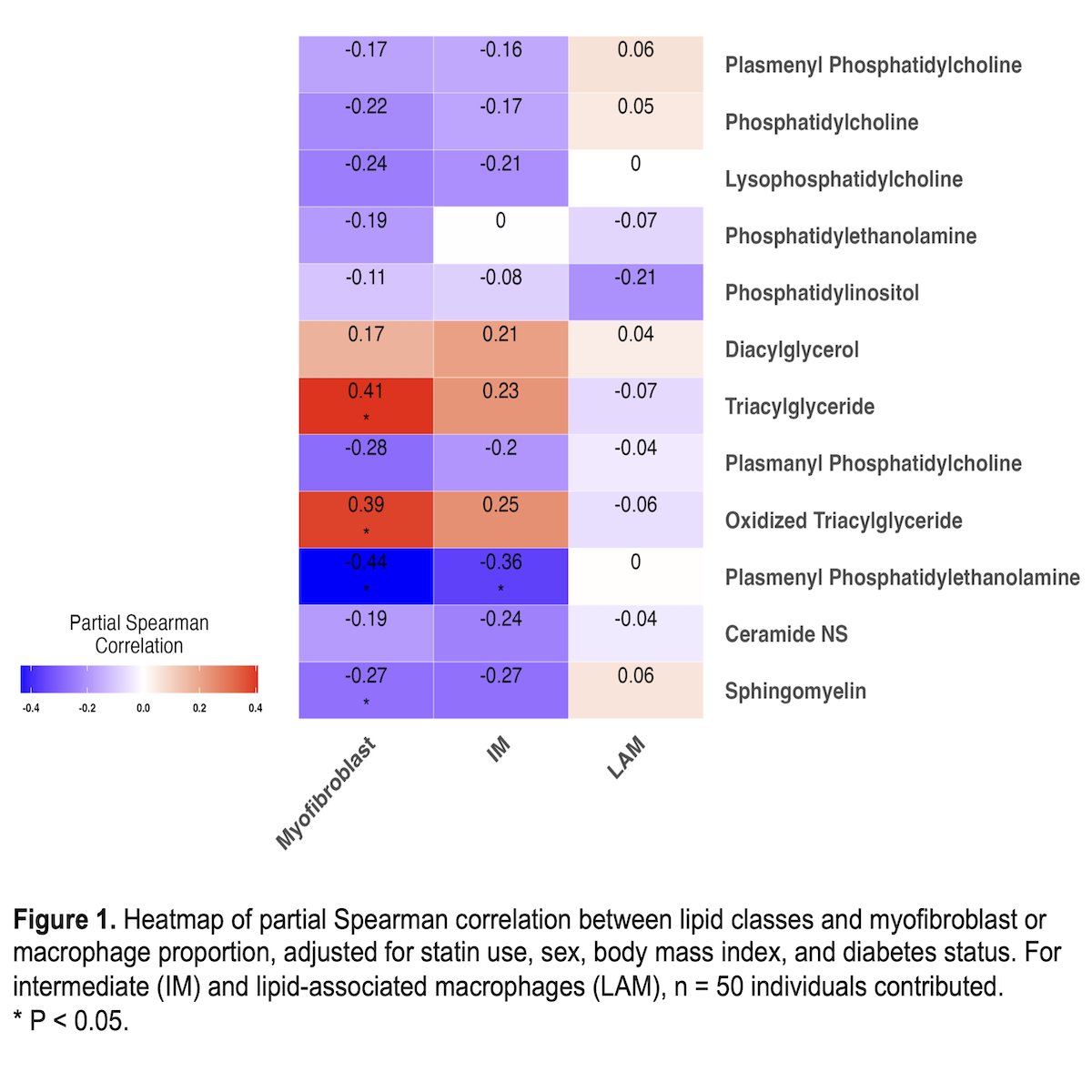
A total of 55 participants were included in this study (non-diabetic=19, prediabetic=18, diabetic=18). The median age was 49 years, BMI 31.5 kg/m2, 73% male, 49% White, and 62% treated with an integrase strand transfer inhibitor-based regimen. A higher proportion of myofibroblasts (pro-fibrotic cells) was positively associated with TG (ρ=0.41, p=0.006) and oxidized TG (OxTG; ρ=0.39, p=0.002) levels, and inversely associated with SM (ρ=-0.27, p=0.03) and plasmenyl phosphatidylethanolamines (plasmenyl-PE) (ρ=-0.44, p=0.004) but not PC (ρ=-0.22, p=0.11) (Figure 1). Higher intermediate macrophages (IMs) were inversely associated with plasmenyl-PE (ρ=-0.36, p=0.04). The proportion of lipid-associated macrophages (LAMs) was not associated with any lipid class.
Conclusions:
In PWH, higher proportion of SAT myofibroblasts was moderately associated with higher TG and OxTG, and inversely related to SM and plasmenyl-PE. IMs and LAMs were not significantly associated with these classes except IMs and plasmenyl-PE. These results suggest that a pro-fibrotic composition of non-adipocyte stromal cell types is related to circulating lipid profiles. Future studies using single nuclei RNA-sequencing will be necessary to evaluate the contribution of adipocyte populations.