Background:
Diffuse large B cell lymphoma (DLBCL) is HIV-associated and the most common type non-Hodgkin lymphoma worldwide. We examined the impact of the HIV epidemic and antiretroviral therapy (ART) roll-out on incident DLBCL in South Africa by comparing characteristics and temporal trends of incident DLBCL between the Black (high HIV prevalence) and the White (low HIV prevalence) populations
Methods:
We identified DLBCL diagnosed in South Africa from 2011-2021 in the pathology-based National Cancer Registry using International Classification of Disease Oncology, 3rd Edition morphology codes. Using direct standardisation, we computed age-specific incidence rates and estimated yearly age-standardised incidence rates (ASIR). We used Joinpoint regression to estimate annual percentage changes (APC) in the ASIR of DLBCL.
Results:
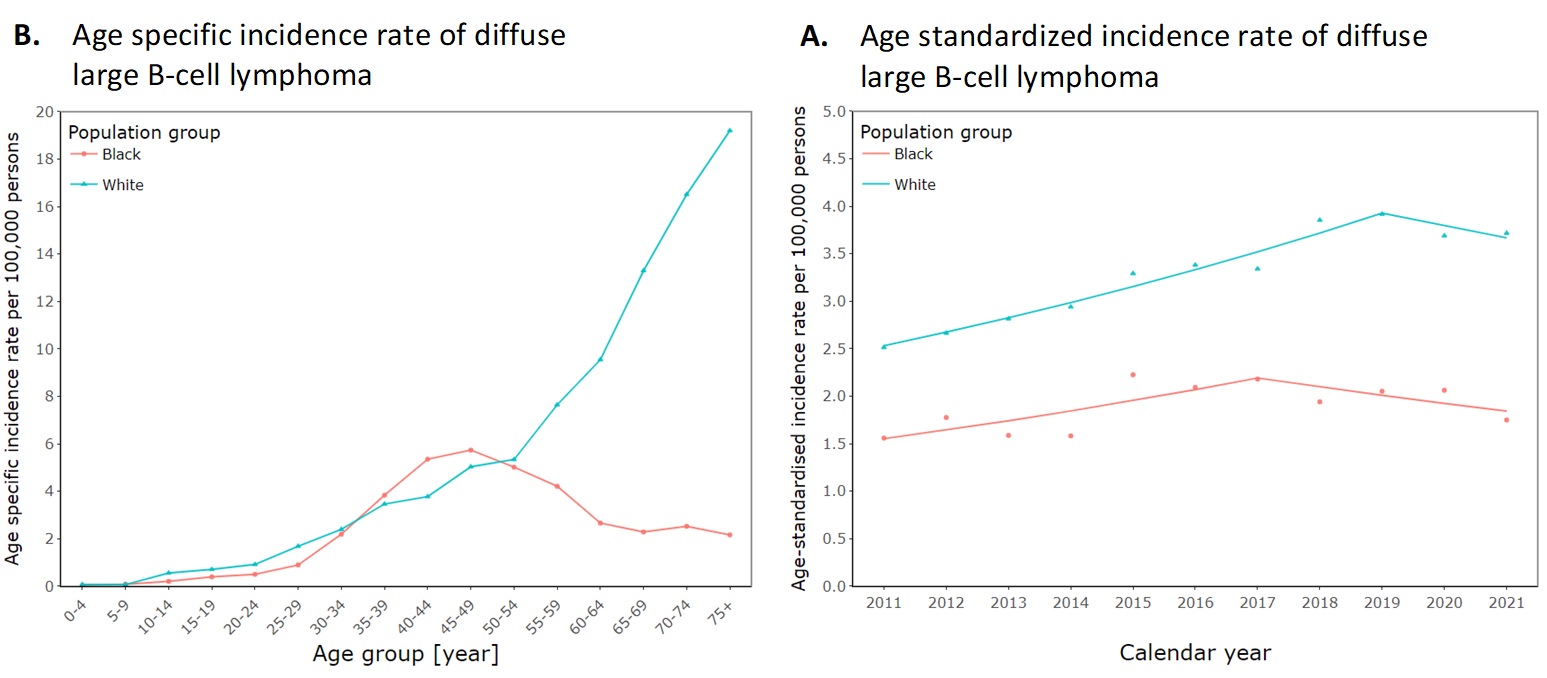
In South Africa, 13,560 DLBCL were diagnosed from 2011-2021; 55% of them (n=7410) were among men. The median age at DLBCL diagnosis was 47 years (IQR=37-59). Two-thirds of incident DLBCL occurred in Black (65% [n=8790]) and 22% in White individuals (n=3006). The incidence of DLBCL was highest among middle-aged adults in the Black population and older White people (Figure A). The overall ASIR of DLBCL per 100,000 persons was 5.8 in the White and 1.8 in the Black population. The ASIR of DLBCL was higher in the White population across all calendar years (Figure B). In the Black population, we noted an annual increase of 5.9% (95%CI 0.02 to 37.1) from 2011-2017 with a declining trend thereafter (APC -4.2%; 95%CI -22.8 to 3.7). Similarly, in the White population, the ASIR of DLBCL showed a yearly increase of 5.6% (95%CI 4.8 to 7.9) from 2011-2019 with a declining trend thereafter (APC -3.4%; 95%CI -8.1 to 2.4).
Conclusions:
Whereas incident DLBCL in the White population mostly occurs among elderly individuals, the high DLBCL incidence rates among middle-aged Black individuals in South Africa indicate that HIV primarily drives incident DLBCL in this population. However, despite the introduction of ART in 2004, the DLBCL rates continued to increase in the Black population for more than a decade and only decreased one year after introducing the universal-test-and-treat policy in 2016. This suggests that wide coverage and timely initiation of ART are needed to reduce the DLBCL incidence in the Black population in South Africa. The reduced DLBCL ASIRs in 2020-2021 might be partially attributed to the COVID-19 pandemic.