Background:
The quality of life of people with HIV (PWH) has significantly increased thanks to potent single pill antiretroviral regimens characterized by a good tolerability. Another milestone has been reached with long-acting (LA) formulations which enable infrequent dosing. Clinical trials of LA agents were mostly conducted in standard populations, leading to a lack of knowledge on their pharmacokinetics in elderly PWH. Physiologically based pharmacokinetic (PBPK) model is a mathematical tool approved by the regulatory authorities used to simulate clinical unknown scenarios. The aim of this study was to determine the pharmacokinetics of LA cabotegravir and rilpivirine in virtual elderly individuals.
Methods:
Our in-house PBPK model built in Matlab®2020a and implemented with an intramuscular framework was verified against clinical observed data for cabotegravir and rilpivirine after oral and intramuscular administration. As for PBPK modelling guidelines, the model was considered verified when the predictions were within 2-fold of clinical observed data. The effect of ageing on the pharmacokinetics of LA cabotegravir and rilpivirine was evaluated by using two separate cohorts of virtual individuals aged 20-50 (50% female) and 65-85 (50% female), respectively. The design of the ATLAS/FLAIR and ATLAS-2M studies was reproduced in our PBPK model and the fold change in elderly relative to young was determined for area under the concentration-time curve (AUC) and trough concentration (Cmin) at steady state.
Results:
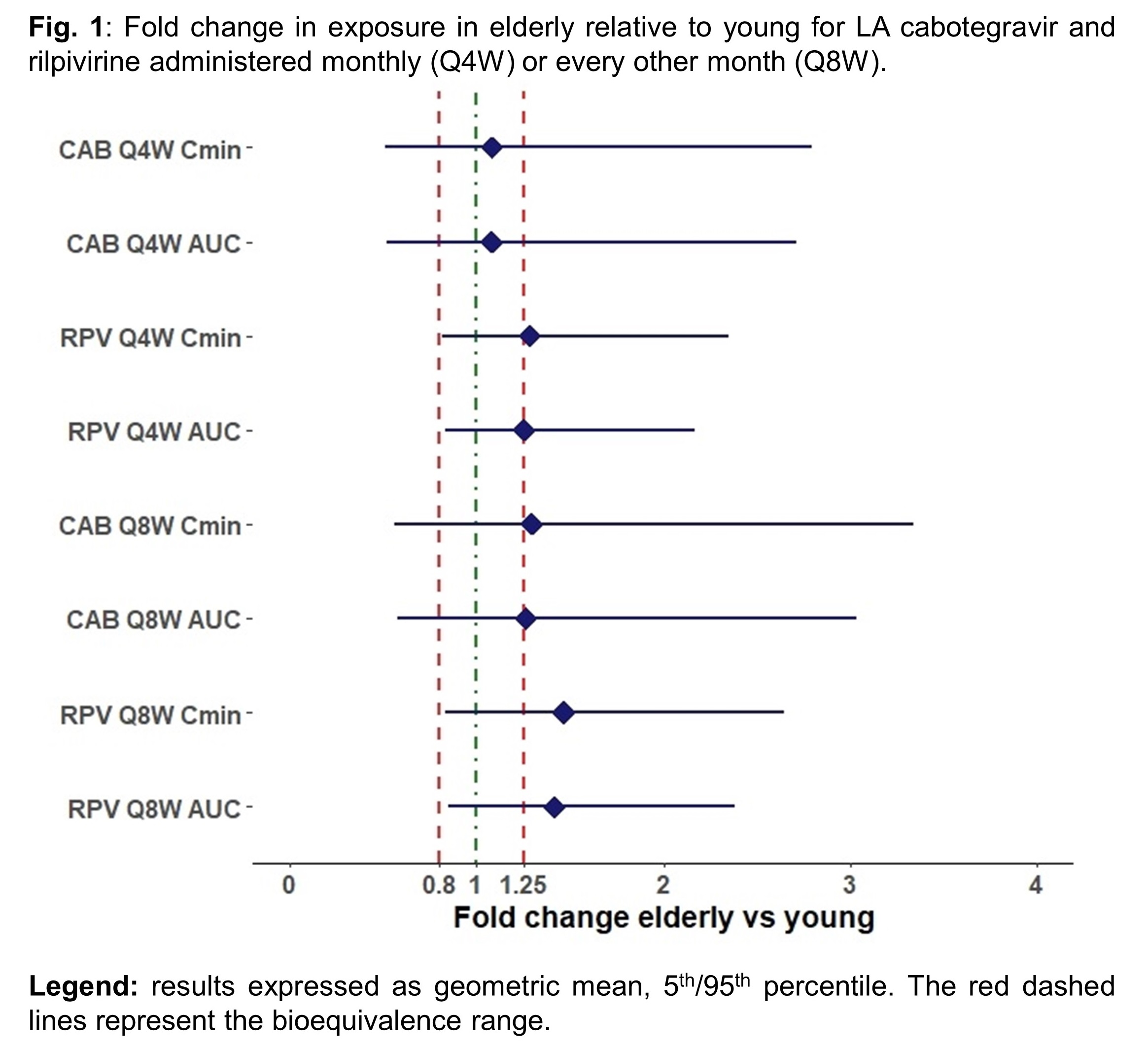
The PBPK model was successfully verified as all the predictions were within 2-fold of clinically observed data. Age related physiological changes did not significantly impact the Cmin and AUC of LA cabotegravir administered every month (Q4W), and the AUC of LA rilpivirine Q4W since the ratios (elderly vs young) were predicted to be within the bioequivalence range (0.8-1.25 fold). On the other hand, the Cmin of LA rilpivirine administered Q4W was 28% higher in elderly relative to young. Additionally, the Cmin and AUC of LA cabotegravir administered every other month (Q8W) were predicted to be 29% and 26% higher in elderly relative to young, respectively. Similarly, the Cmin and AUC of rilpivirine Q8W were 46% and 41% higher in elderly (Fig. 1).
Conclusions:
Age related physiological changes are predicted to modestly increase the AUC and Cmin of LA cabotegravir and rilpivirine. Thus, elderly PWH could possibly be at lower risk for sub-optimal drug exposure at the end of the dosing interval.