Background:
A recent study of structural brain volumes during acute HIV infection (AHI) revealed evidence of hypertrophy among individuals in Fiebig stages III-V compared to Fiebig I-II. The present study incorporated multiple neuroimaging modalities (structure and function), blood markers of inflammation and immune dysregulation, and psychosocial determinants of health using ensemble machine learning to more comprehensively characterize brain integrity in late vs. early AHI and discover potential explanatory factors.
Methods:
112 Thai males with AHI (age 20-46) enrolled in RV254/SEARCH010 were included in the analysis. Features classifying individuals into early (Fiebig I-II; n=32) vs. late (Fiebig III-V; n=80) AHI were ranked using gradient-boosted multivariate regression (GBM) with repeated cross validation. Predictors included demographic, HIV disease, cognitive, neurologic exam, mental health, substance use, plasma immune/inflammatory, and multimodal 3T neuroimaging (i.e., volumes, resting state connectivity, diffusion, and spectroscopy) indices collected at enrollment.
Results:
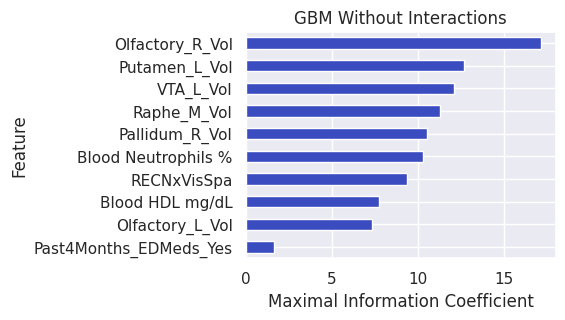
The GBM identified a combination of variables that classified individuals into early vs. late Fiebig with an average F1 score (a metric of model performance) of .82. Individuals in late Fiebig stages exhibited larger regional volumes in the olfactory cortex, putamen, raphe nucleus, and pallidum. Smaller volumes among late Fiebig individuals were noted in the ventral tegmental area, along with lower blood neutrophil percent and high-density lipoproteins, greater functional connectivity between the right executive control network and visuospatial networks, and lower use of erectile dysfunction medication.
Conclusions:
Findings demonstrate that brain alterations in late vs. early stages of AHI associate with distinct multidimensional parameters: larger regional volumes observed together with lower immune levels (i.e., neutrophils) suggest that viral-immune dysregulation already underway in late Fiebig stages manifests as hypertrophy via neuroinflammation. Additionally, we reveal evidence of brain-behavior relationships via recent substance use and ventral tegmental area volume, a region implicated in addictive behaviors. Resting state connectivity differences may also reflect disrupted structural/functional integration. Psychosocial and immune processes operative during the first weeks of AHI and their effects on brain integrity may explain variability in long-term outcomes for those starting ART at later stages.