Background:
HIV-1 infection can greatly impact the NK cell phenotypic and functional repertoire. This is highlighted by the expansion of a rare population of FcRγ– NK cells exhibiting adaptive immune characteristics in people with HIV-1 (PWH). While current antiretroviral therapy (ART) effectively controls HIV-1 viremia and disease progression, its impact on HIV-associated NK cell abnormalities remains unclear.
Methods:
We performed a 4-year longitudinal analysis characterizing conventional and memory-like NK cells from PWH (n=60) participating in the AIDS Clinical Trials Group (ACTG) A5321 study, all of whom initiated ART in ACTG trials during chronic infection and had well-documented consistent HIV-1 suppression. Peripheral blood mononuclear cells collected at 4 weeks, 1 year, and 4 years post-initiation of ART were characterized. The phenotypic and functional profiles of NK cells, as well as frequencies of FcRγ− NK cells, were determined by flow cytometry analysis at baseline and following a 24h exposure to rhIL-18 (500 ng/ml) and rhIL-12p70 (50 ng/ml). Plasma CMV/EBV IgG antibody titers were measured by ELISA, and CMV/EBV viremia was determined by real-time qPCR. The BD Rhapsody™ Express System was used for single-cell multiomic analysis.
Results:
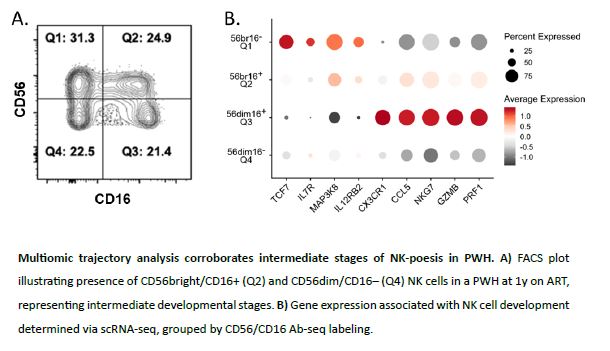
Throughout the first 4 years of ART, a skewed repertoire of highly specialized antibody responsive but rhIL-18/IL-12 unresponsive FcRγ– memory-like NK cells persisted. This was accompanied by an increase in both CD57 and KLRG1 expression and a decrease in NKp46 within the total NK cell population, indicative of a progressive differentiation toward senescence. These characteristics were linked to increasing antibody titers to CMV, with CMV viremia detected in 35% and 29% of PWH at years 1 and 4 of ART. Interestingly, 40% of PWH displayed an atypical NK cell subset distribution based on differential expression patterns of CD56 and CD16. Single-cell multiomic trajectory analysis (Figure) revealed that these abnormal subsets likely represent intermediate stages of NK-poiesis, a phenomenon partially corrected between 1 to 4 years of ART.
Conclusions:
Our findings indicate that HIV-associated NK cell irregularities persist in PWH despite long-term, effective ART. This underscores the need to better understand the causative mechanisms contributing to these immune irregularities. The study also provides a rationale for exploiting in HIV remission trials the selectively expanded antibody responsive FcRγ– NK cells that are maintained in PWH during ART.