Background:
An increased understanding of immune cell populations in the female genital tract (FGT) is essential for efforts to decrease risk of HIV and other sexually transmitted infections and to develop vaccines that induce mucosal responses. To-date, FGT immune cell collection has utilized techniques that require a healthcare provider and a speculum exam, creating a barrier to participation and limiting longitudinal studies. To overcome these challenges, we developed a novel method to collect leukocytes from cervicovaginal fluid (CVF) utilizing Softdiscs.
Methods:
Non-menstruating persons with vaginas of reproductive age were asked to self-insert disposable Softdiscs and wear for up to 4 hours on three sequential days. After self-retrieval, CVF was removed from the disk via washing, followed by treatment with DTT to thin mucus, passage through a cell strainer, and cryopreservation. Cells were subsequently thawed, enriched for CD45+ cells using magnetic cell separation, and stained with a 28-color antibody panel focused on T cell phenotyping.
Results:
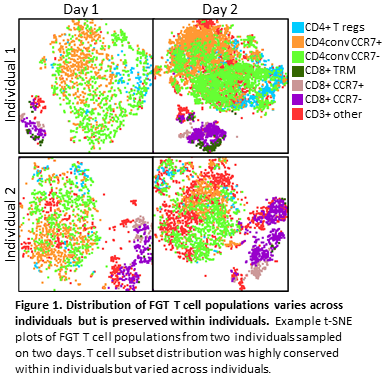
Across 15 samples (5 participants x 3 days) we recovered high numbers of CD45+ cells (median: 6,233; range: 212-57,703), CD3+ T cells (median: 1,182; range: 12-11,554), and CD19+ B cells (median: 1,072, range: 8-4,690). Of CD3+ T cells, frequencies ranged from 37-87% for CD4+ T cells and 7-55% for CD8+ T cells. Within CD4s there were both regulatory (Tregs) and conventional subsets and within CD8s both tissue resident (TRM) and migratory populations. To demonstrate reproducibility, we compared populations across days and found that within individuals the distribution was strongly conserved. For example, comparing the first and last day of sampling, the frequency of CD4s (R2=0.78, p=0.12) and CD8s (R2=0.90, p=0.04) of CD3s, Tregs of CD4s (R2=0.75, p=0.15), and TRM of CD8s (R2=0.93, p=0.02) were all correlated. Of note, while population distributions were strongly conserved within individuals, they were unique across individuals (Fig 1).
Conclusions:
Collection of CVF from Softdiscs represents a novel, non-invasive approach to study FGT immune cell populations, including both tissue resident and migratory memory T cell subsets. This approach yielded high quality immune cells which could be cryopreserved and had reproducible population structure and phenotype across multiple days. This self-collected sampling will empower a more diverse population of individuals to participate in future studies of FGT immunity.