Background:
People living with HIV (PLWH) who reengage after falling out of care remain high risk for repeat disengagement, but few tailored reengagement strategies exist to support sustained engagement in this diverse. We used best-worst scaling (BWS) experiments to understand client and health care worker (HCW) preferences for features of reengagement strategies.
Methods:
We conducted BWS surveys among clients returning to care after being >30 days late to an appointment without ART as well as HCWs at 4 public HIV clinics in Lusaka, Zambia. Participants identified the statements about varied reengagement care features and services that they most and least preferred across multiple choice sets. For both groups, we used multinomial-logit models to quantify relative preference scores, scaled from 0-100, and latent class analysis to identify unique preference profiles for strategies.
Results:
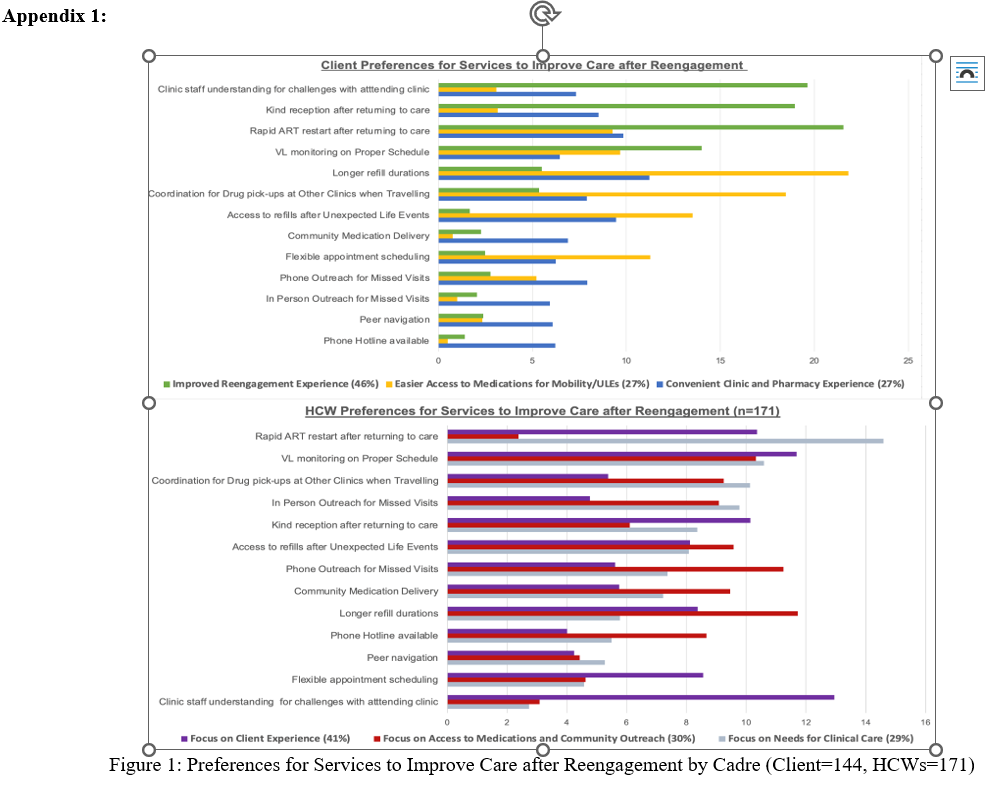
We administered BWS surveys among 144 PLWH returning to care (55% female, median age 38 [IQR 19-81]) and 171 HCWs (8% clinical officers,16% nurses, 46% lay HCWs, 30% other). Overall, clients preferred rapid ART reinitiation (normalized score 14.9), longer ART refills (12.0), kind reception at return (11.1),empathy for care challenges (10.9),timely viral load (VL) monitoring (10.2) and coordinating drug pick-ups at other clinics when travelling (9.8).HCWs prioritized timely VL monitoring (11.2), longer drug refills (8.8), flexible ART access after unexpected life events (ULEs) (8.8), kind receptions (8.6), and rapid ART restart (8.3).We identified 3 unique preference profiles for each group.46% of clients preferred improved reengagement experiences (e.g.,rapid ART restart, kind receptions),27% desired easier ART access for travel/ULEs (e.g.,longer refills, travel drug pick-ups, flexible ART access), and 27% sought more convenient clinic experiences (e.g.,longer refills, rapid ART restart, flexible ART access). Amongst HCWs, 41% prioritized improving client experience (e.g.,flexible appointments, kind receptions), 30% focused on ART access and client outreach (e.g., longer refills, community ART delivery), and 29% prioritized clinical needs (e.g.,rapid ART restart,VL monitoring) (Figure).
Conclusions:
Although clients and HCWs had similar overall preferences, there are unique preferences profiles that differentially prioritize improvements to client experience, access to medications, or addressing clinical needs. Multipronged, tailored reengagement strategies are needed to address the needs for all returning PLWH.