Background:
Non-alcoholic fatty liver disease (NAFLD) is a leading cause of liver-related morbidity in people living with HIV (PLHIV). Obesity is an important risk factor but NAFLD also occurs in lean PLHIV, with possible different underlying pathophysiology. Proteomics facilitate biomarker discovery and may help identify biological mechanisms.
Methods:
We analyzed data from 1050 PLHIV with transient elastography measurements from the 2000HIV cohort, a Dutch multi-center study amongst virally suppressed PLHIV (NCT03994835). Proteomics was available (Olink® Explore, 2367 proteins) from 1036 individuals (98.7%). Differentially expressed proteins (DEP) were compared between PLHIV with and without liver steatosis (controlled attenuation parameter ≥ 248 dB/m) and with and without liver fibrosis (liver stiffness measurement ≥ 7.0 kPa) using a limma model. We stratified by BMI group (lean [BMI < 25 kg/m2 or < 23 kg/m2 in PLHIV from Asian descent] vs. overweight/obese PLHIV [other BMI]). Functional pathways from the GO biological processes, KEGG and Reactome libraries enriched with DEP were identified using Metascape. DEP were correlated to HIV-specific characteristics and antiretroviral therapy (ART).
Results:
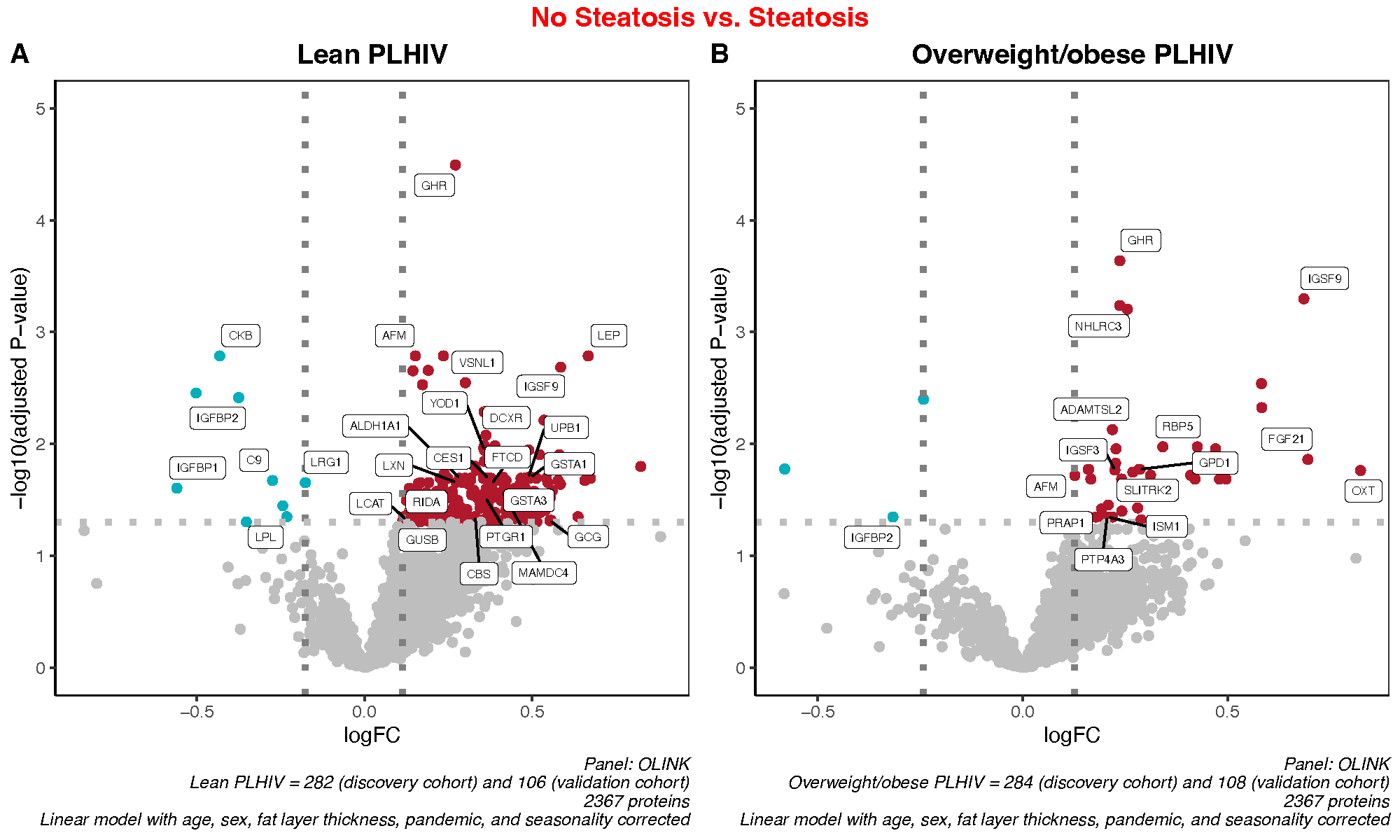
Plasma proteome of PLHIV with steatosis or fibrosis were altered from those without steatosis or fibrosis, respectively. DEP in PLHIV with steatosis were enriched in metabolic pathways, whereas DEP in PLHIV with fibrosis were enriched in interleukin-10 (IL-10) signaling, cell-adhesion, and amino acid metabolism. More DEP (n = 27) were identified in lean PLHIV with versus those without steatosis compared to overweight/obese PLHIV (n = 15), and only four DEP were shared between lean and overweight/obese PLHIV, i.e. IGFBP2, GHR, AFM, and the novel protein IGSF9. IGSF9 was also DE in PLHIV with fibrosis. Especially in lean PLHIV, multiple DEP were associated with HIV-characteristics including HIV duration and CD4 nadir and current ART (NNRTI and INSTI).
Conclusions:
PLHIV with steatosis and fibrosis have an altered plasma proteome including upregulation of proteins involved in metabolism, cell-adhesion and IL-10 signaling. Steatosis signatures differed between lean and overweight/obese PLHIV. Furthermore, our findings indicate involvement of HIV-specific factors in the pathogenesis of lean NAFLD, and we discovered the potentially novel NAFLD biomarker IGSF9.