Background:
Immunological non-responders (INRs) are people living with HIV (PLHIV) that fail to restore CD4+ T-cell counts despite suppressive antiretroviral therapy (ART). INRs are at a higher risk for non-HIV related mortality and morbidity, such as non-aids malignancies. IL-2 induced CD4+ T-cell count increases did not effect clinical endpoints in previous trials, indicating a persistent qualitative defect despite increases in absolute CD4 counts.
Methods:
PLHIV with CD42 years of suppressive ART were defined as INRs, and were compared to immunological responders (IRs) with CD4>500 during ART. The 2000HIV study (clinicaltrials NTC03994835) enrolled 1895 PLHIV, which were divided into a discovery and a validation cohort. We used logistic, and rank based regression to analyze clinical data, extensive flow cytometry panels for monocytes, DC-, NK-, B-, CD4+T- and CD8+T- cells, and monocyte, and lymphocyte cytokine production capacity after stimulation with various stimuli in INRs compared to IRs. Analyses were corrected for sex at birth and age (all), seasonality (flow cytometry), and current monocyte/lymphocyte count (cytokine production).
Results:
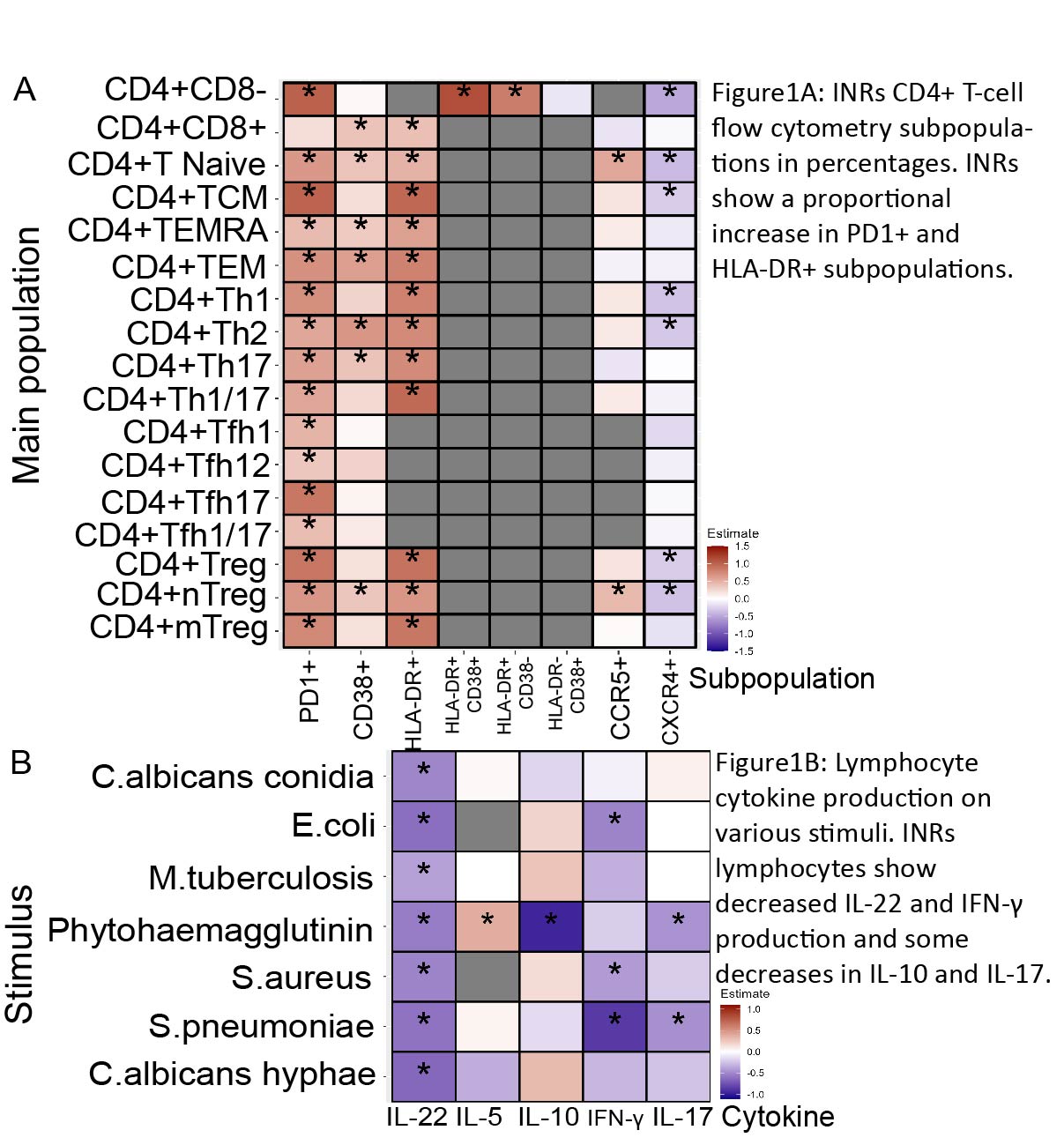
The discovery cohort consisted of 62 INRs and 1224 IRs, the validation cohort of 26 INRs and 243 IRs. INRs were older, had more advanced HIV disease before starting ART and more often had a history of non-AIDS related malignancy. INRs had lower absolute CD4+ T-cells in all subsets analyzed. Activated and immunosenescent related subpopulations (HLA-DR+, CD38+; PD1+) were proportionally increased throughout CD4+ T-cell subsets (Figure 1A). CD8+ cells had proportionally increased HLD-DR+ subsets. Results were confirmed in the validation cohort. Monocyte and granulocyte phenotypes were not different between INRs and IRs in both cohorts. Moreover, INRs lymphocytes produced less IL-22 and IFN-γ in response to most stimuli, and less IL-10 and IL-17 to some stimuli (Figure 1B) indicating impaired cytokine production capacity. In contrast, monocyte cytokine production was comparable between INRs and IRs. Findings in the validation cohort were consistent. Proportional CD4+CD38+HLA-DR+ and CD4+PD1+ subsets were inversely correlated to lymphocyte cytokine production.
Conclusions:
We show an increase in immunosenescence CD4+ subsets and impaired lymphocyte function in INRs in a large cohort of PLHIV. These qualitative immune defects may therefore contribute to the observed increased morbidity in INRs.