Background:
Transgender and nonbinary (trans) people face a disproportionately high HIV risk, yet adherence to pre-exposure prophylaxis (PrEP) remains low. Conventional approaches to PrEP programming have not sufficiently engaged trans populations. Gender affirmation and conditional economic incentives could help improve the uptake of PrEP, but user-centered approaches are needed to inform the optimal design of trans-specific PrEP programming.
Methods:
We conducted a discrete choice experiment among 385 trans adults in Seattle/King County, Washington State to inform the optimal design of a conditional economic incentive (CEI) program that would provide free long-acting injectable PrEP (LA-PrEP) and gender-affirming care. We used a best-best elicitation method where respondents were first asked to select their best option from three hypothetical choice profiles (Program A, Program B, or No Program), and to then select their second-best option from the remaining two profiles. We used a rank-ordered mixed logit model for main results, and estimated respondents’ marginal willingness-to-accept each program attribute.
Results:
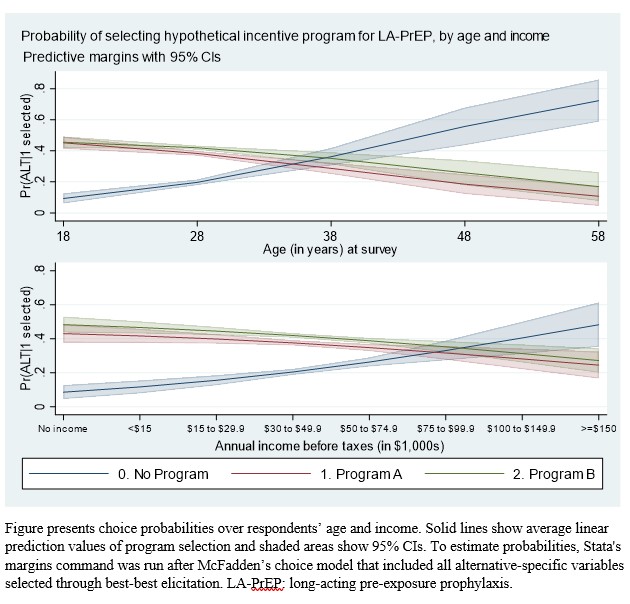
We find the optimal program design would: (1) deliver incentives in cash, (2) confirm LA-PrEP adherence via blood testing, (3) provide counseling in-person, and (4) provide co-prescriptions for injectable gender-affirming hormones. From a maximum yearly incentive amount of $1,200, respondents were willing to forgo up to $795 to receive incentives in cash (instead of voucher) and up to $587 to receive injectable rather than oral hormones. As shown in the figure, the probability of choosing a hypothetical program over no program waned as adults aged (>40 years) and as annual income increased (>$75,000/year).
Conclusions:
Conditional economic incentives may be effective for improving LA-PrEP adherence among trans adults who are younger and have fewer financial resources. A randomized trial is needed to confirm the validity of the DCE for predicting actual program uptake.