Background:
Global data indicates a significant disparity in HIV case finding and treatment coverage between pediatrics and adults. To enhance HIV case finding and treatment for pediatrics within the HIV care continuum, targeting significant hotspot areas may be essential. This study investigates spatial patterns of the disease in Kenya, identifying hotspots to prioritize program resources for epidemic control efforts among pediatrics.
Methods:
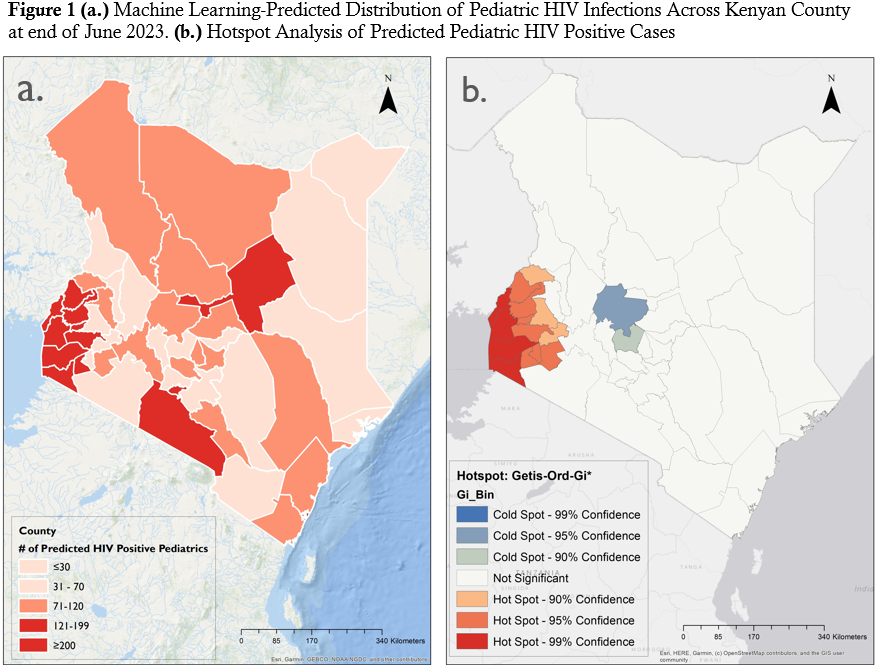
We utilized national HIV testing data for HIV-positive pediatrics under 15, combined with 2022 Kenya Demographic and Health Survey indicators, to train various supervised machine learning (ML) algorithms. Prediction accuracy for the ML models was evaluated using root mean square error and mean absolute error. The most effective model, ‘tuned Lasso Regression’, predicted the number of new HIV-positive pediatrics across 47 Kenyan counties based on national data between October 2022 and June 2023. These predictions were georeferenced at the county level for geostatistical analysis. Global spatial autocorrelation techniques based on Moran’s I (MI) test revealed HIV infection distribution patterns, while hotspot analysis using Getis-Ord (Gi*) spatial statistics identified significant clusters of pediatric HIV cases among neighboring counties.
Results:
By the end of June 2023, we predicted 3,160 pediatric HIV cases, a slight increase from the 3,092 cases reported by the national program between October 2022 and June 2023. A spatial autocorrelation analysis of pediatric HIV infections in Kenya revealed significant clustering for both reported (z-score=3.22, MI=0.21, p-value<0.001) and predicted cases (z-score=4.92, MI=0.36, p-value<0.001). The increased z-score in predicted cases suggests heightened clustering intensity, indicating that new pediatric HIV cases are predominantly localized. Hotspot analysis using the Getis-Ord Gi* statistic pinpointed these significant clusters to twelve counties in the Southwestern region of Kenya.
Conclusions:
The spatial distribution of new pediatric HIV cases was non-homogeneous. This study pinpointed key geographical areas for prioritizing pediatric HIV infection control. This study will provide policymakers with essential insights to optimally allocate testing and treatment services to areas with the greatest needs.