Background:
While neuropsychological tests are designed to test specific cognitive abilities, a person who performs well in one task tends to perform well in others (‘general cognitive ability’ or g-factor). Previous studies showed that g-factor is associated with higher functional connectivity measuring by resting state fMRI. If perinatal HIV exposure can negatively affect white matter integrity, it’s possible that the development of g-factor in these individuals might differ from individuals with no exposure. Here, we studied domain-general cognitive ability and how it differed between older and younger adolescents with different HIV statuses.
Methods:
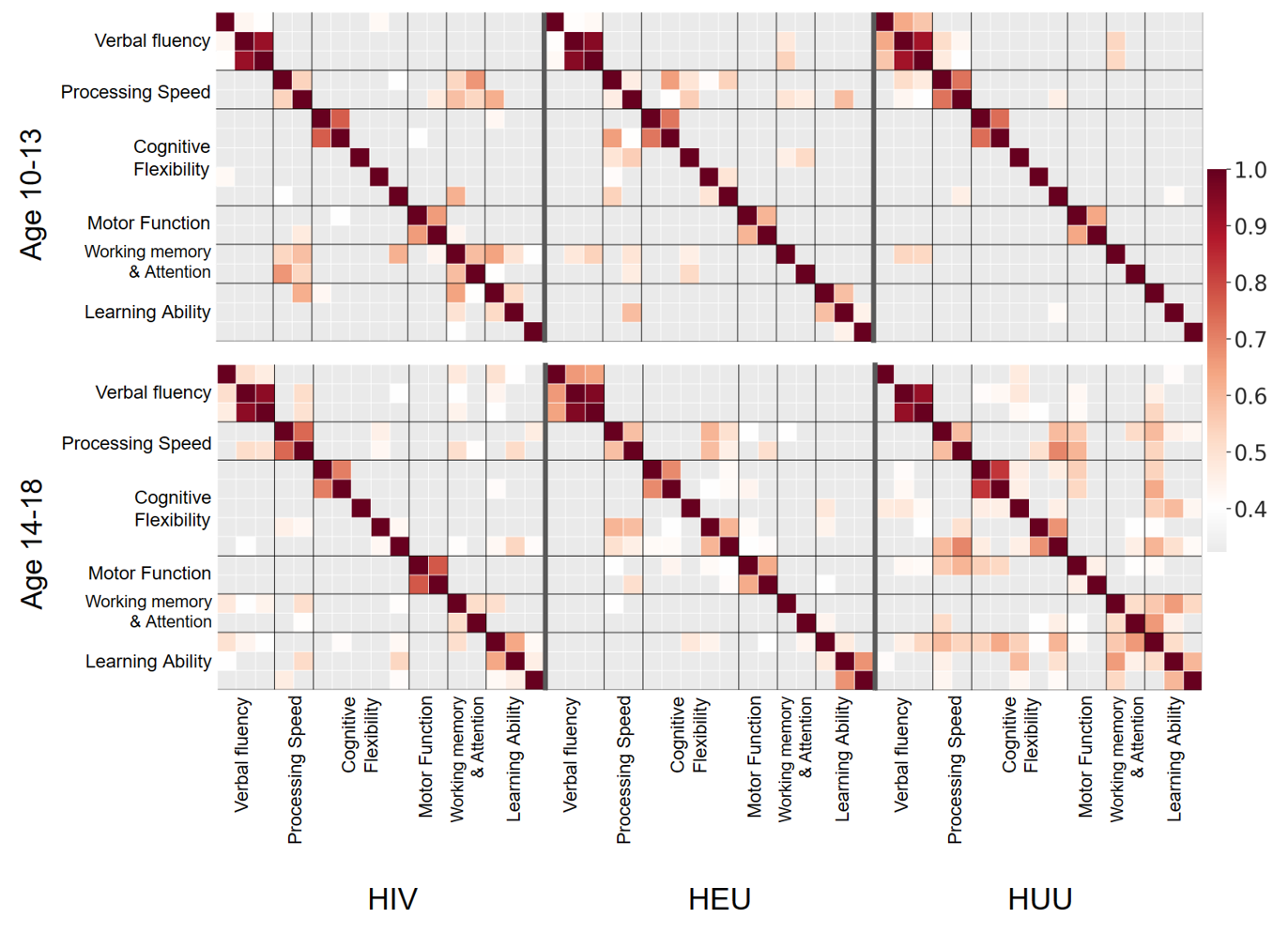
Data from the RESILIENCE study, a cohort conducted from 2015-2019, were analyzed to assess the correlation among 17 neuropsychological tests subscores across 6 cognitive domains. Participants were grouped by perinatal HIV status: HIV-exposed infected children group (HIV), HIV-exposed uninfected children group (HEU), and HIV-unexposed uninfected children group (HUU); and age: early adolescents (10-13 years) and middle adolescents (14-18) years. The number of moderate-to-strong correlations (Spearman’s correlation coefficient ≥ 0.4) between cognitive tests were used as a marker of domain-general cognitive ability. We used permutation methods for the test statistic. Connection strength within and between domains was also explored.
Results:
There were 96 HIV, 80 HEU, and 98 HUU in the early adolescent group and 105 HIV, 51 HEU, and 46 HUU in the middle adolescent group with matched genders. At the baseline, we found no difference in the number of connections. However, the HUU group showed a significantly greater increase in connections across age ranges (difference = 34) compared to the HIV (difference = 9, p<0.05) and HEU (difference = 5, p<0.001) groups. There was no difference in the increase of connections between the HIV and HEU groups. Additionally, only the HUU group had a significant decrease within-domain connection strength across age groups (average coefficient difference = 0.17, p<0.001).
Conclusions:
Our study reveals a slower progression of general cognitive ability among individuals exposed to HIV. This observation aligns with the well-documented impact of HIV on white matter integrity and extends our comprehension of cognitive development within the HIV-exposed population. Our future research will involve a direct exploration of functional connectivity and its relationship with the g-factor.