Background:
Cryptococcal meningitis (CM) causes 19% of HIV-related deaths, and 10-week mortality rates with current treatments are high (25-45%). Risk stratification at disease presentation with tailoring of treatment could reduce mortality. Higher fungal loads are strongly associated with mortality; but obtaining fungal loads requires serial CrAg LFA dilutions or quantitative fungal cultures (QFC), both are time and resource consuming, need expertise, and are difficult to implement in resource limited settings (RLS). The IMMY CrAgSQ is an improvement on the widely used IMMY CrAg LFA with comparable diagnostic performance, yielding a semi-quantitative (SQ) score. Previous studies involved fewer HIV-CM patients and did not definitively evaluate the utility of CrAgSQ in predicting mortality. We conducted a study on stored plasma and CSF samples from the AMBITION trial to evaluate whether CrAgSQ can predict outcomes.
Methods:
810 patients with HIV-CM were enrolled onto the Ambition Phase 3 randomised clinical trial evaluating CM therapy in Botswana, Zimbabwe, Malawi, Uganda and South Africa. Stored plasma and CSF samples collected at disease diagnosis before treatment were tested using CrAgSQ, yielding a score of 1-5. Clinical outcomes and laboratory data were documented during 10 weeks of follow-up. Associations between CrAg SQ scores in plasma and CSF and 2- and 10-week mortality were examined.
Results:
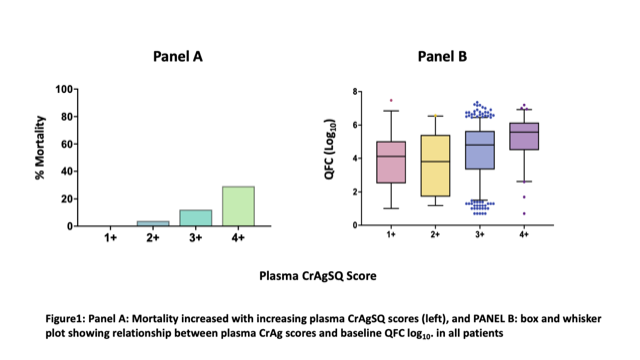
756 CSF and 745 plasma collected from 796 Ambition Trial patients were assessed; 61% of the patients were male, median age was 37 (IQR 32-43 years), and median CD4 count was 27 (IQR 10-58 cells/uL). Overall mortality was 13% and 23% by 2 and 10 weeks. In plasma, 0.13% (1/745) were negative, 4.03% (30/745) had an SQ score of 1, 3.49% (26/745) 2, 83.62% (623/745) 3, and 8.72% (65/745) 4. In CSF, 1.32% (10/756) were negative, 7.01% (53/756) had an SQ score of 1, 5.69% (43/756) 2, 63.76% (482/756) 3, and 22.22% (168/756) 4. CrAg SQ scores in plasma (Figure) and CSF positively correlated with QFCs. Increasing CrAg SQ scores in plasma were strongly associated with increasing mortality risk at 2- and 10-weeks. Mortality was 0% (0/22) in those with plasma SQ score of 1, 4.4% (1/23) 2, 13.9% (75/540) 3, and 34.55% (19/55) 4 (p for trend <0.001).
Conclusions:
Plasma CrAgSQ is a promising prognostic tool for 2-week mortality in patients with HIV-CM, making it a viable option for RLS. Further research is warranted to establish how it could be used to stratify management in individuals presenting with HIV-CM.