Background:
Social determinants of health underly persistent disparities in the rates of non-communicable diseases (NCDs) across communities but have been understudied in people with HIV (PWH).
Methods:
We assessed associations between the CDC’s Social Vulnerability Index (SVI) and NCD burden and risk in PWH in care at the Vanderbilt HIV Clinic from Jan 2009-Dec 2019. The SVI is a census-tract-level measure of deprivation based on 16 factors, grouped into a total score and four themes (socioeconomic status, household composition/disability, minority status/language, and housing/transportation); higher SVI indicates greater neighborhood vulnerability. SVI was assigned using residence at enrollment or first visit after Jan 2009. NCDs included cardiovascular, liver, metabolic, and chronic kidney disease (stage ≥3), as well as non-AIDS defining cancers. Multivariable proportional odds logistic and Poisson regression models were used to assess the relationship between baseline SVI (total and themes) and both baseline and longitudinal NCDs (respectively), accounting for clustering and adjusting for age, substance use, gender/HIV risk factor, race/ethnicity, prevalent NCDs, antiretroviral therapy, depression, HIV RNA, hepatitis C, year, CD4 count, time since HIV diagnosis, and body mass index. Continuous variables including SVI were modeled using restricted cubic splines with 3 knots.
Results:
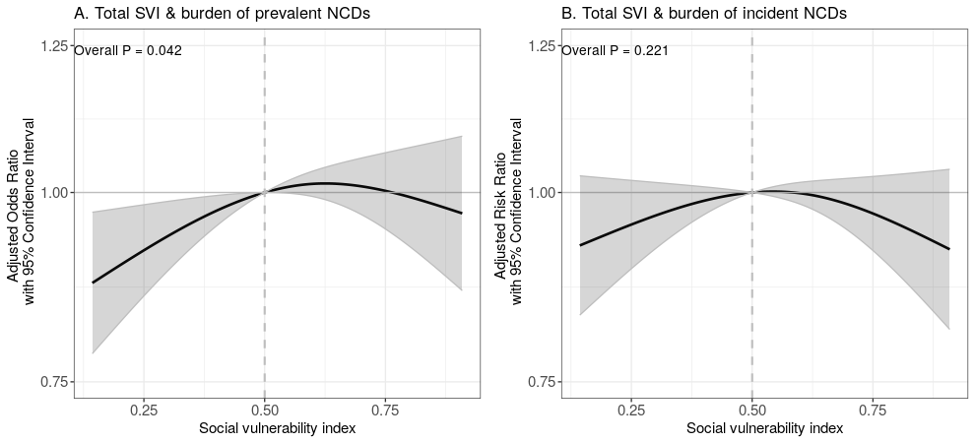
Among 4440 PWH, median age was 41 years, 59% were men who have sex with men, 21% were cis-gender women, 41% were non-Hispanic Black, and 50% were non-Hispanic white. Median total SVI was 0.6 (IQR: 0.3-0.8) and median follow-up was 2.6 years (IQR: 1.1-5.4). At baseline, 44% had ≥1 NCD and 19% had ≥2 prevalent NCDs. Of 2442 PWH without prevalent NCDs, 32% developed NCDs during follow-up. Of 1916 patients with prevalent NCDs, 41% developed additional NCDs. Lower SVI was associated with lower number of prevalent NCDs (Figure 1a). In separate analyses, SVI socioeconomic status and household composition/disability themes were also associated with prevalent NCD burden (all p<0.05). In longitudinal analyses, there was no significant association between SVI and the risk of incident NCDs (Figure 1b).
Conclusions:
Neighborhood vulnerability was associated with NCD burden among PWH, even after adjusting for individual characteristics, though confidence intervals included the null for incident NCDs. Relationships between neighborhood-level social determinants of health and NCD comorbidity among PWH warrant further study.