Background:
HIV is associated with increased risk of heart failure and with worse outcomes after diagnosis with heart failure. However, whether cardiomyopathy phenotypes vary by HIV status and whether HIV is associated with similarly increased risk within a contemporary population who receives care within a safety-net system is unknown.
Methods:
In this observational study, using an electronic health record database of all individuals with diagnosed heart failure within the San Francisco Health Network, a municipal safety-net system, from 2001-2019, we compared individuals with and without HIV (defined by ICD code and at least one CD4 count or viral load) in terms of baseline characteristics, heart failure phenotypes by ejection fraction and presumed etiology, and outcomes after heart failure diagnosis including all-cause mortality (linked to national death statistics), and hospitalization for heart failure.
Results:
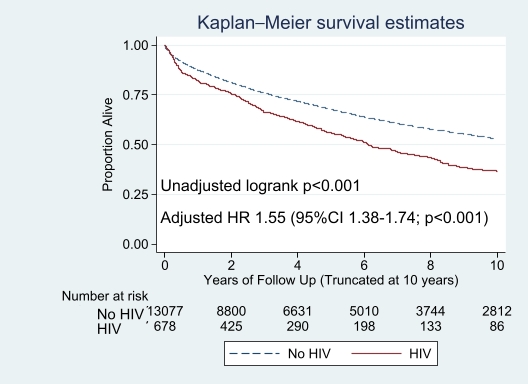
We included 14,829 individuals with HF, of whom 697 (4.7%) had HIV. Although 41% without HIV were female, only 19.7% with HIV were female with HIV, and the median age was 63 without HIV and 53 with HIV at time of HF diagnosis. Among those with HIV, the median nadir CD4 count was 133 (IQR 44, 275), and at HF diagnosis was 356 (IQR 173, 566). Persons with HIV had much higher proportions with documented alcohol, tobacco, opioid, cocaine and methamphetamine use (p<0.001 for each). 38% vs 33% had a reduced ejection fraction to <40% (p=0.009). There were no differences in the proportion with prior myocardial infarction or obstructive coronary artery disease on angiography. Median survival was 6.1 years (95% CI 5.4-7.1) among people with HIV compared to 11.3 years without HIV (95%CI 10.7-11.7). HIV was associated with higher risk of all-cause mortality (HR 1.55 95%CI 1.38-1.74; p<0.001; Figure) and lower odds of heart failure hospitalization (OR 0.51; 95%CI 0.39-0.66); p<0.001). Lower nadir CD4 and CD4 at the time of HF diagnosis were associated with worse survival: HR 1.37 for nadir < 200 (95%CI 1.08-1.75; p=0.009) and HR 1.69 for current <200 (95%CI 1.34-2.13; p<0.001), respectively. Viral load greater than 500 copies/ml was not associated with mortality (HR 1.02; 95%CI 0.80-1.31; p=0.87).
Conclusions:
Among people with HF who receive care within a municipal safety-net system, HIV infection is associated with diagnosis with HF ten years earlier and significantly elevated risk of mortality despite lower risk of HF hospitalization.