Background:
The introduction of combination anti-retroviral therapy (cART) has led to increased life expectancy of persons living with HIV (PWH) and a reduction in the prevalence of HIV-associated neurocognitive disorder. As PWH grow older, it is important to understand the cognitive trajectories of PWH compared to people without HIV (PWoH) and how treatment efficacy impacts age related cognitive changes.
Methods:
PWoH and PWH (virally undetectable; viral load ≤50/ml, PWHU; and detectable; PWHD) were recruited and repeatedly administered a simple cognitive battery – Category Fluency (language), Hopkins Verbal Learning Test (learning subtest), Trails A (psychomotor/processing speed), and Trails B (executive function) – that were combined to form a composite (NPZ4). The composite was formed by normalizing scores to baseline performance (flipping timed tests so that lower values means poorer performance), and averaging Z-scores. The association between cognition and age was assessed for each group in a generalized additive mixed model. Education, ethnicity, sex, and time since first cognitive test were included as covariates.
Results:
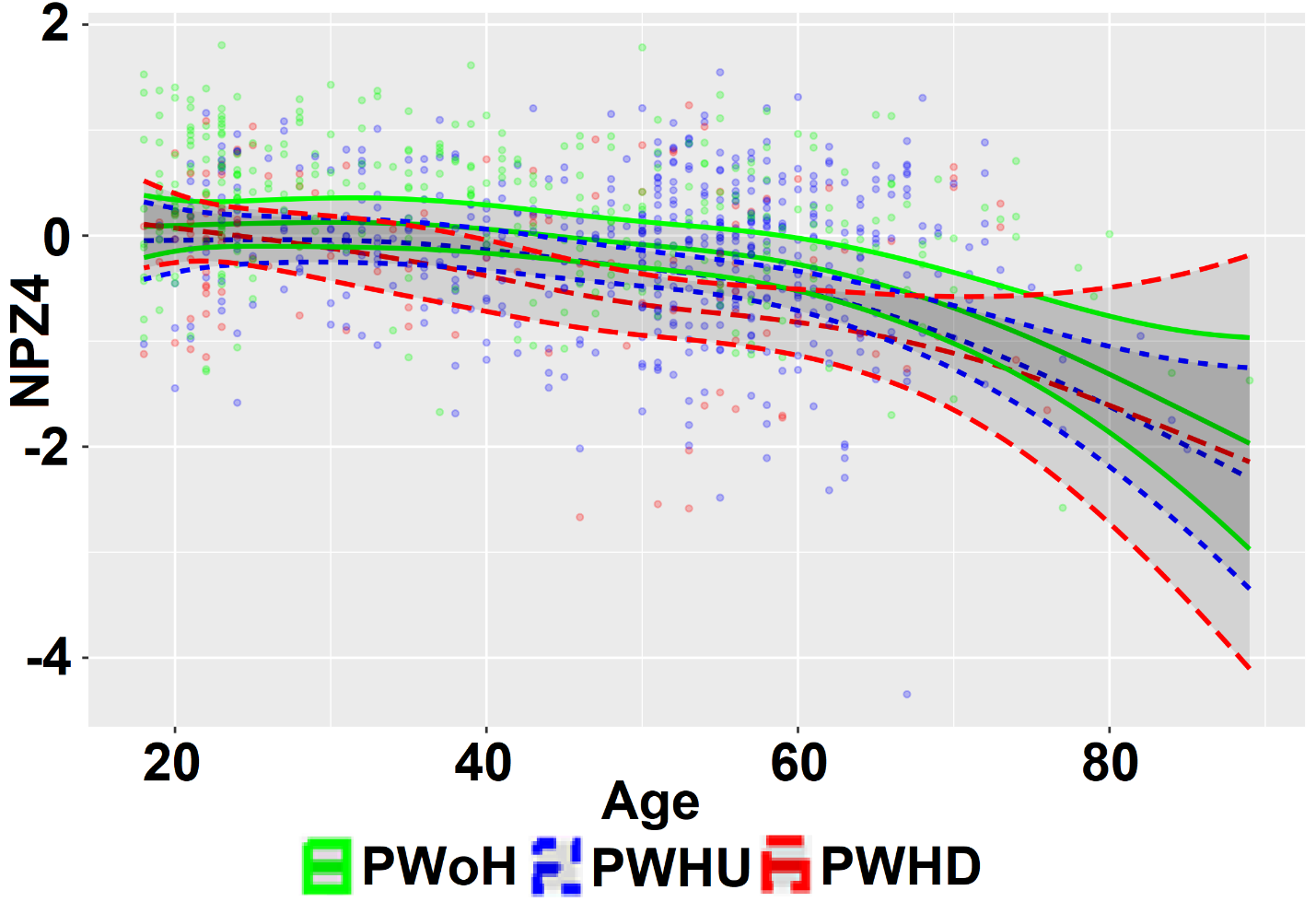
A total of 679 participants (279 PWoH, mean (standard deviation) age 40 (17) years old; 305 PWHU, age 49 (14) years old; 95 PWHD, age 40 (17) years old), tested up to 6 times for a total of 968 data points, were analyzed. Age was associated with cognition in each group, with cognition worsening with increasing age. The overall effect significantly differed between all groups (PWoH > PWHU > PWHD). The shape of the age-cognition relationship was identical for PWoH and PWHU, only significantly shifted downward. Shape significantly differed in PWHD, resulting in a steeper, steadier decline in cognition with increasing age relative to PWoH and PWHU.
Conclusions:
While there is a decrease in cognition associated with HIV, the age-cognition relationship mirrors PWoH when virologically controlled. Older, uncontrolled PWH are at greater risk for cognitive decline and should be the focus of future studies.