Background:
Transgender women (TW) are at increased risk for HIV but are underrepresented in research. We investigated how the initiation of gender affirming hormone therapy (GAHT) impacts HIV reservoir (size and activity) and inflammation.
Methods:
TW with HIV starting estradiol-based GAHT were recruited at two clinics in San Diego, CA and Houston, TX. Participants were on antiretroviral therapy (ART) and had suppressed HIV-1 RNA during the study. Blood and plasma were collected prior to starting GAHT and longitudinally 2, 4, 6, 9, 12, and 18 months post GAHT initiation. Historical samples from cisgender men with HIV were matched by age, CD4+ T cell count, duration of HIV, and time on ART. At each timepoint, we measured estradiol and testosterone by ELISA, cell-associated HIV RNA (unspliced and multiple spliced) and HIV DNA (total and 2-LTR) by ddPCR, and 41 cytokine/chemokines by Luminex. We used a linear mixed effects model with HIV reservoir values as outcomes, and time, group, and their interaction as predictors along with a random intercept. Partial least squares-discriminant analysis (PLS-DA) was used to predict gender groups using cytokine/chemokines. Error rates were estimated using k-fold cross-validation.
Results:
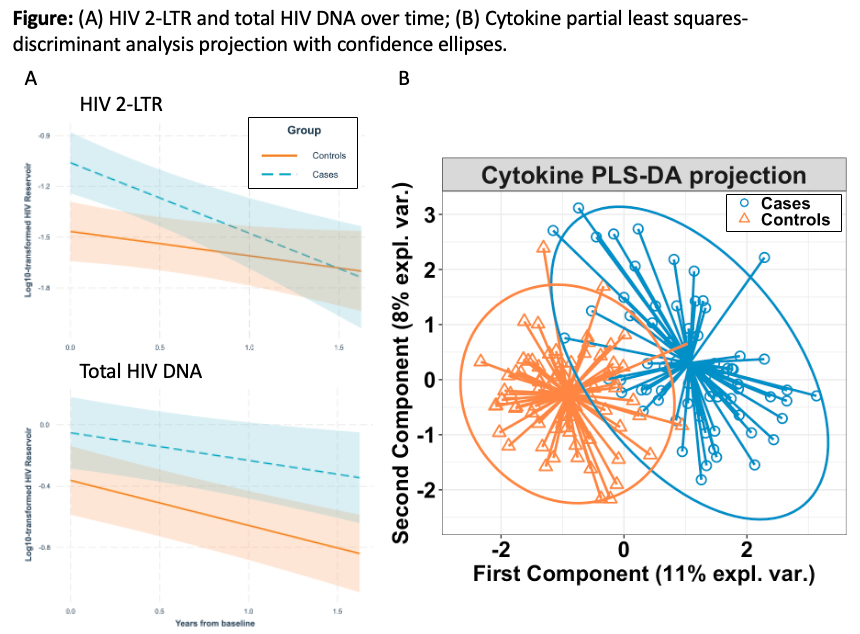
A total of 22 TW were enrolled. Nine were lost to follow-up including one suicide, one homicide, and two imprisonments. A total of 77 samples from TW and 79 samples from cisgender controls were analyzed. Compared to cisgender controls, TG women had higher overall estradiol (145.83 vs 45.62 pg/mL, p<0.001), and lower testosterone concentrations (226 vs. 436 ng/dL, p<0.001) with a sharp decrease after baseline. Overall, TW had higher HIV DNA levels (both total and 2LTR). We observed a significant interaction between time and gender group for 2-LTR but not for total HIV DNA (Panel A). There was no difference in unstimulated cellular HIV RNA between groups. Using our cytokine/chemokines dataset, we accurately predicted gender group in the PLS-DA model with an error rate of 10% (Panel B).
Conclusions:
TW had increased HIV DNA with faster decline in 2-LTR circle after initiating GAHT compared to cisgender men, supporting estradiol’s inhibition of residual HIV replication. TW had unique immune signatures, which might impact HIV disease outcomes and comorbidities. Our study underscores the challenges associated with recruiting and studying this unique population, emphasizing the need for trauma-informed care and tailored research efforts.