Background:
The HIV reservoir stablished in the early stages of the acute HIV infection (AHI) and at the time of ART initiation is a major barrier to curing HIV. In this study, our objective was to assess the longitudinal impact of initiating ART during early HIV infection on the composition of the viral reservoir, in comparison to a cohort of individuals with similar immunological status treated during the chronic phase of the infection.
Methods:
The VHAHI cohort is an ongoing ambispective cohort (n=147) including patients with confirmed AHI in Barcelona (Suanzes et al, IJID, 2023). We included 25 participants from the VHAHI cohort that started ART within 180 days (early treated: ET), and 16 individuals with similar immunological status that started ART during the chronic phase of HIV infection (late treated: LT). We performed a longitudinal analysis after 0, 6, 12 and 36 months of ART in 13 ET and 7 LT participants. Moreover, a cross-sectional analysis using samples from 23 ET and 14 LT participants who had been on ART a median of 68 months (45-101) was performed. We measured total HIV DNA using qPCR, and frequencies of intact and defective proviruses using the IPDA.
Results:
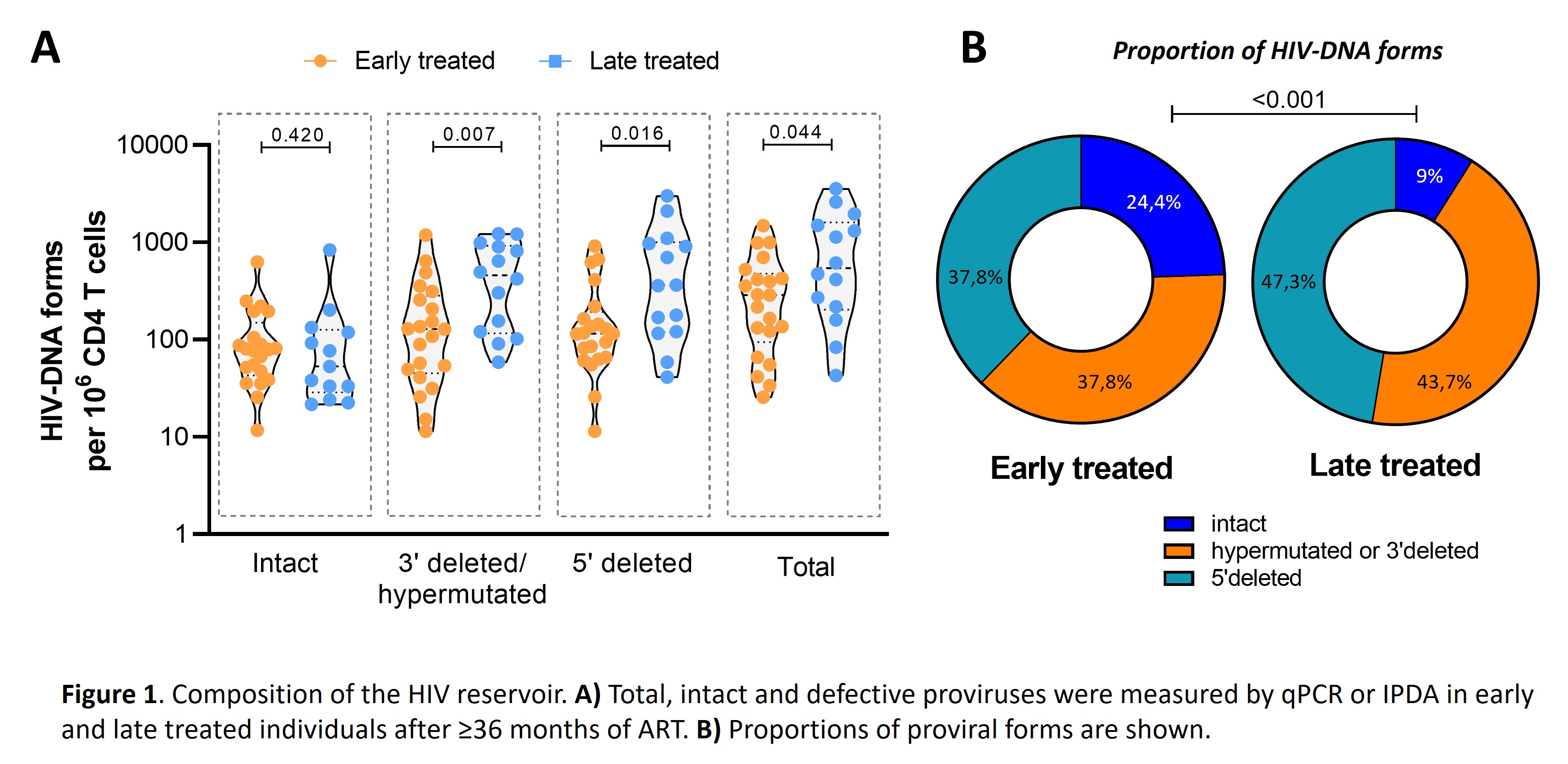
Thirty-eight (92.7%) participants were men. The median time from the estimated date of infection to ART initiation was 75 days (42-128) in the ET group and >180 days in the LT group. Pre-ART HIV viral load was higher in the ET group (p=0.035), but there were no significant differences in CD4+ and CD8+ counts, or CD4+/CD8+ ratio pre-ART (p>0.05). In the longitudinal analysis, all viral forms, included intact, declined over time in both cohorts. However, defective proviruses plateaued after 6-12 months of ART in LT participants, while continuous decay was observed in the ET group (p=0.01). Participants in the cross-sectional analysis maintained virological suppression for a median of 63 months (39-95) without significant differences between ET and LT (p>0.05). Total HIV DNA and defective proviral DNA levels were significantly higher in LT participants (Fig.1A). Although we did not observed differences in intact proviral DNA between groups (Fig.1A), the contribution of the intact form to the total pool of HIV-DNA was significantly higher in ET participants (Fig.1B).
Conclusions:
The intact HIV reservoir after ART remains similar between ET and LT individuals with comparable immunological status. Further research is necessary to determine the implications of these findings for HIV cure strategies.