Background:
The persistent reservoir of cells carrying a functional provirus is the barrier to HIV eradication. One approach to reservoir depletion is sequential activation of latent virus, followed by purging of HIV-expressing cells. initially it was hoped that once cells were activated, viral cytopathic effect or host immune responses would clear the reservoir, but recent studies using mAbs have shown greater effects. We have armed antibodies with cytotoxic agents to enhance killing of HIV-infected cells, independent of ADCC or complement activity. We screened >200 mAbs to identify those most effective at delivering the toxic moiety, and found that the anti-gp41 mAb 7B2, conjugated to ricin A chain, is safe and effective in SHIV-infected macaques. However, it was immunogenic, limiting its utility. We therefore sought to develop less immunogenic immunotoxins (ITs) and antibody drug conjugates (ADCs).
Methods:
We screened drugs for cytotoxicity on resting lymphocytes . ADCs were prepared by chemical conjugation to 7B2. Cytotoxicity of ADCs was compared to ITs on Env-expressing cells. Antiviral effects were measured in tissue culture. The effect of ADCs and ITs on metabolism and transcription in HIV-infected cells was studied by NMR-based metabolomics and RNAseq.
Results:
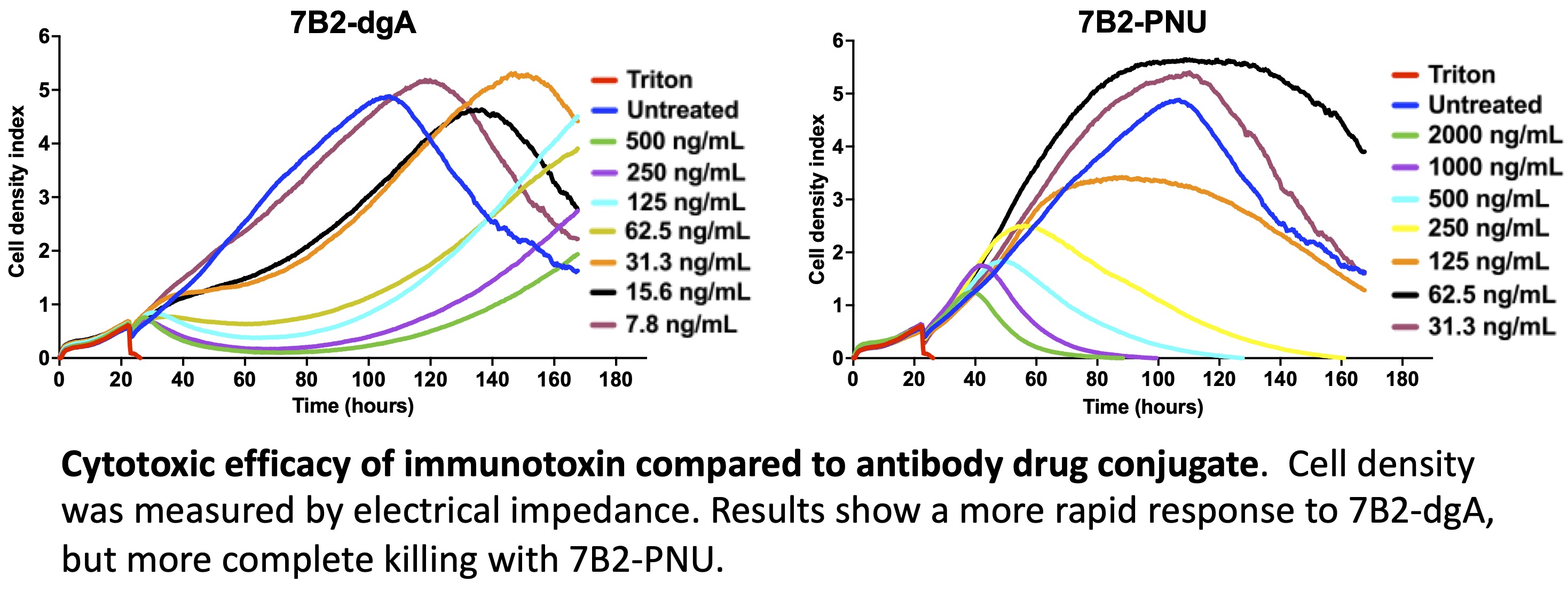
PNU-159682, an anthracycline, killed resting cells. We compared 7B2-PNU (ADC) to 7B2-ricin A (IT) in vitro. Cytotoxicity of the IT was 10X greater than the ADC on Env+ target cells, whereas neither IT nor ADC killed Env- cells. The ADC required >24 hr to initiate cytotoxicity; IT killing began within 6 hr. The ADC elicited bystander killing of ENV- cells when mixed with Env+ cells, the IT did not. At 6 hours, metabolomic analyses of IT-treated cells, but not ADC-treated or untreated cells, demonstrated elevated amino acids and choline and depressed taurine, creatine, and fumarate. At 24 hr the metabolic profiles of all three groups diverged. Similarly, the transcriptome of IT-treated cells diverged at 6 hr, while at 24 hours, the three transcriptional profiles were distinct. Pathway analysis indicated significant up-regulation of transcriptional control and death pathways in both IT and ADC treated cells
Conclusions:
Cytotoxic immunoconjugates (ICs) targeted by anti-gp160 mAbs are potent killers of cells expressing HIV Env, work independently of Fc-effector functions, and are potentially useful in HIV eradication. Understanding how different ICs kill cells will guide their clinical application.