Background:
People living with HIV have accelerated biological aging and a higher prevalence of aging-related comorbidities and geriatric outcomes. Clonal hematopoiesis (CH), an aging-related cellular phenomenon that is linked to adverse clinical outcomes, is increased in people living with HIV. Here we evaluated geriatric outcomes in older adults with and without HIV to determine whether HIV or CH is associated with geriatric outcomes.
Methods:
Participants were enrolled from the ARCHIVE study, a prospective observational cohort of adults with and without HIV >55 years, and evaluated for CH and geriatric outcomes. Frailty was measured by the FRAIL questionnaire, which categorizes individuals as frail, pre-frail and robust. Phenotypic age acceleration (PAA) was defined as the difference between phenotypic age, measured by nine biochemical and blood cell characteristics, and chronological age. Quality of life (QoL) was measured by the CASP-19 scale. Descriptive statistics compared baseline characteristics across HIV status. Multivariable logistic and linear regression was used to evaluate for associations between HIV and CH, and geriatric outcomes.
Results:
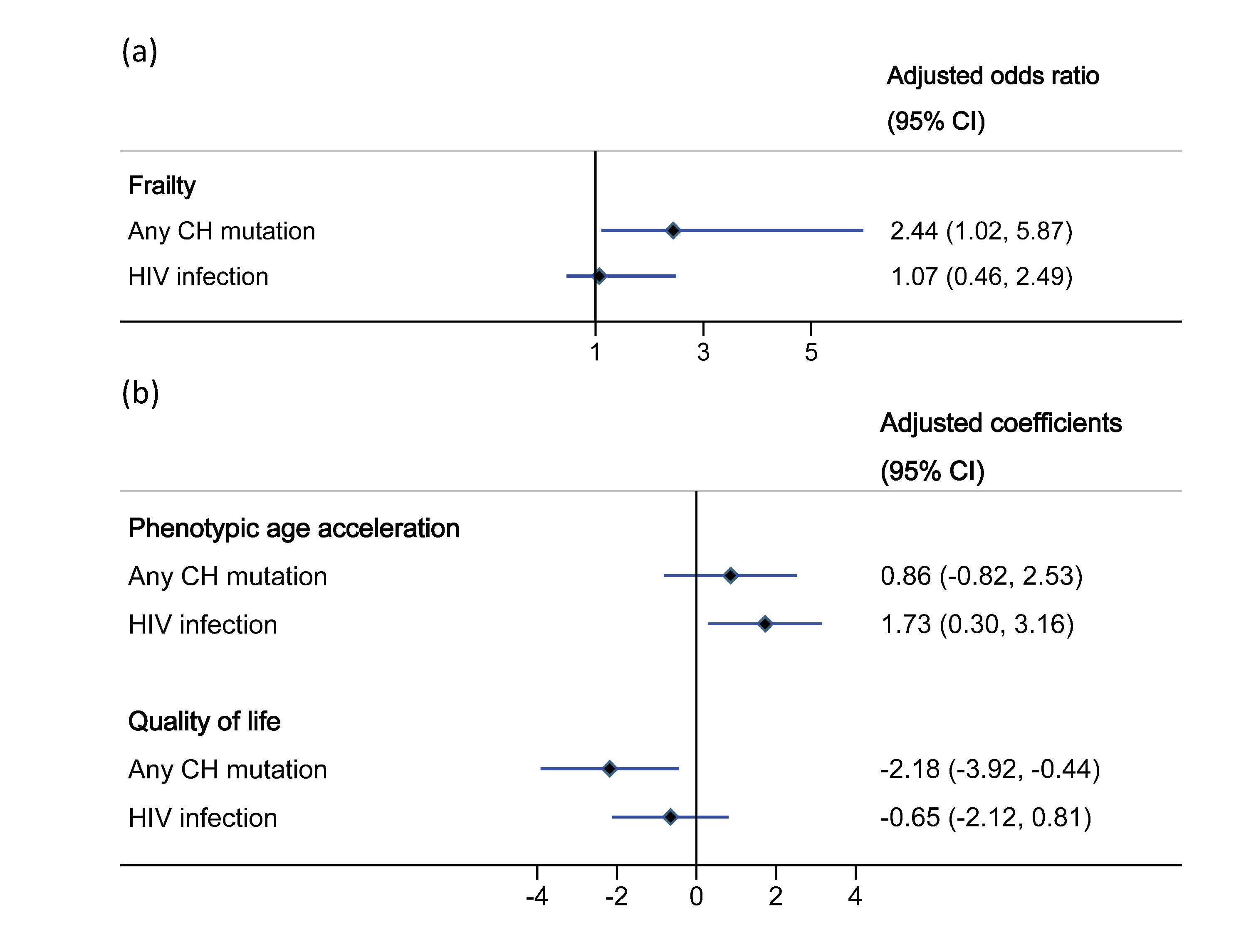
Of 344 participants, 175 had HIV and 169 did not. The median (interquartile range; IQR) age was 67 (62,72) years, 97% identified as male, 61% had a body mass index>25, 41% reported ever smoking, and 54% reported being diagnosed with cardiovascular disease. Overall, 23% had at least one CH mutation (27% of those with HIV and 18% of those without HIV; p=0.045), 7% were frail, the median (IQR) PAA was 0.6 years (-2.5,5.0), and the median (IQR) QoL score was 36 (29,39) out of 57. Participants with HIV had a median (IQR) duration of HIV of 27 (18,33) years and a median (IQR) CD4 nadir of 246 (143,372) cells/mm3; all but one participant had a suppressed viral load. In adjusted regression analyses (Figure), HIV infection was independently associated with PAA (coefficients 1.73, 95% confidence interval [CI] 0.3-3.16, p=0.02) and CH was independently associated with reduced QoL (coefficients -2.18, CI -3.92, -0.44, p=0.01) and being frail (vs. pre-frail/robust; odds ratio 2.36, CI 1.01-5.63, p=0.049).
Conclusions:
In the ARCHIVE cohort, HIV was associated with PAA and CH, and CH was associated with frailty and reduced QoL. While our results warrant further exploration, they suggest that CH may be used as a biomarker for geriatric outcomes that may prioritize individuals for interventions designed to reduce geriatric outcomes and promote healthy aging.