Background:
Metabolic dysfunction-Associated Steatosis Liver Disease (MASLD) is a high prevalent condition in people living with HIV (PLHIV) and cardiovascular events appear to depend on the presence of advanced stages of MASLD. Indeed, the underlying insulin resistance and liver fibrosis have demonstrated complex interlinked connections affecting cardiovascular damage evolution. Our objective is to analyze the usefulness of two easy-to-use surrogate biomarkers of insulin resistance and liver fibrosis in the prediction of major cardiovascular events (MACE) in PLHIV.
Methods:
A retrospective cohort of PLHIV receiving ART with metabolic disorders (metabolic syndrome, DM2, arterial hypertension, and obesity) and clinically suspected MASLD was studied. We recorded all MACE occurring during follow-up, and we calculated TyG and FIB-4 indexes from the blood results performed at the initial visit in the cohort. TyG>4.68 was considered as severe insulin resistance risk. FIB-4 cut-off values considered for significant fibrosis were adjusted by hepatitis C virus (HCV) coinfection background: >1.3 for non-hepatitis C and >1.45 for HCV coinfected. TyG>4.68 plus FIB-4>1.3/1.45 was considered as risk-combination-index. Cox models were developed to evaluate the effect of risk-combination-index in the prediction of MACE.
Results:
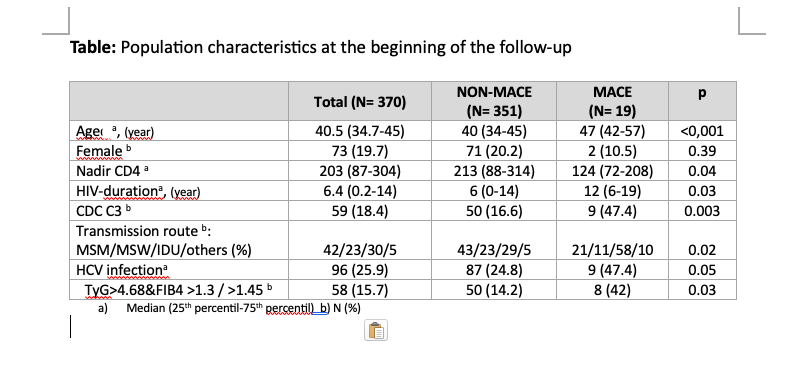
We studied 370 subjects with a median follow-up time of 175 (131-191) months. Main baseline characteristics are shown in table 1. HCV-ab were positive in 25.9% of subjects, all of them were treated and had undetectable HCV RNA during follow-up. A total of 19 MACE (8 myocardial infarction, 6 stroke, 5 peripheral arterial disease) were registered. Along follow-up 39% developed metabolic syndrome, 37% hypertension and 17.6% DM2. TyG>4.68 was found in 56% of subjects and FiB-4>1.3/1.45 in 29.5%, these proportions being significantly higher in PLWH with MACE (74% and 55% respectively). The proportion of subjects with a risk-combination-index was 42% in MACE-population vs 14% in non-MACE-population (p<0.05). Cox regression model adjusted by age, HIV infection duration and HCV coinfection showed that risk-combination-index was associated with MACE: HR 2.6 (CI95% 1.02-6.6; p=0.04).
Conclusions:
The combined interpretation of TyG and FIB-4 indexes, as surrogate markers of insulin resistance and a proxy of liver fibrosis might have a potential predictive value of major cardiovascular events in PLHIV. We recommend routine use of these indexes in the care of PLVIH with metabolic disorders.