Background:
Immune activation, a hallmark of chronic HIV infection, is a major contributor of HIV pathogenesis, even in the context of viral suppression by anti-retroviral therapy. The magnitude of immune activation during HIV infection is both established early and is more predictive of the rate of disease progression than plasma viral load. Elucidating the critical events in acute HIV infection (AHI) associated with disease progression will facilitate the design of new approaches to achieve HIV remission.
Methods:
To investigate the dynamics of inflammation and immune activation during AHI, we utilized samples from 17 Thai and 26 East African participants in the RV217 AHI study. We measured the levels of 26 soluble markers of inflammation inclusive of chemokines, cytokines, and markers of microbial translocation starting from pre-infection through AHI. We determined the dynamics of cellular immune activation by assessing CD4 and CD8 T cell activation during AHI using flow cytometry. The level and frequency of immune activation was used to predict a CD4 T cell count <350 using nonparametric rank-based testing, logistic regression, and cumulative incidence. The prediction capability of identified markers was also examined by Area under the Receiver Operating Characteristic (AURCO) curve.
Results:
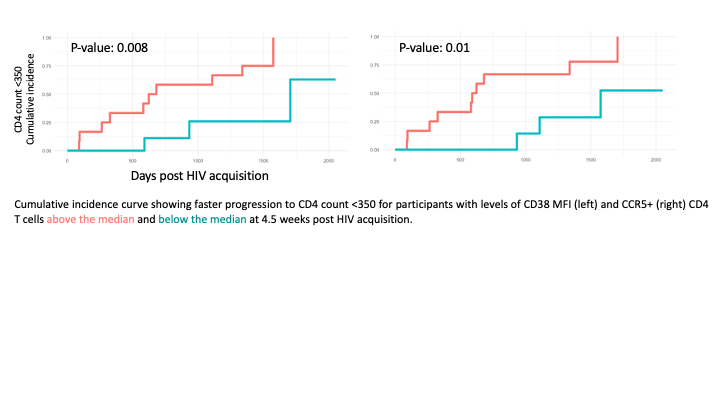
The level of soluble and cellular markers of immune activation between East Africa and Thailand significantly differed between regions both before and during AHI. Similarly, variable signatures of immune activation were associated with peak and set point viral loads for each region. IP-10, IL-8 and IL-10 levels were associated with peak viral load in Africa but not in Thailand. Levels of IL-1 pre-infection in Thailand, but not in East Africa, were inversely associated with peak and set point viral loads. Combining datasets, higher levels of CCR5 and CD38 expression on CD4 T cells at 4.5 weeks post 1st HIV RNA positive test (around set point viral load) were predictive of reaching a CD4 count <350 independently of region or viral load.
Conclusions:
Our results show that the frequency of CD4 T cells expressing CCR5 and CD38 at set point viral load is associated with faster disease progression independent of viral load. This suggests that CD4 T cells circulating with an activated phenotype associated with susceptibility to viral entry may be predictive of immune pathology.