Background:
High-risk people with HIV (PWH) such as individuals who use methamphetamine (MA) are most likely to benefit from HIV eradication strategies and yet they often have high rates of suboptimal ART adherence. No study to date has evaluated whether PWH with adequate viral suppression and who use MA have elevated levels of systemic inflammation and residual viral transcription during ART, which may pose additional challenges to HIV cure in this population.
Methods:
We performed a pilot study of 20 PWH with and without MA use (10 HIV+MA+, 10 HIV+MA-). Inclusion criteria were confirmed HIV-1 infection and undetectable viral load (<40 copies/mL) for at least 1 year. HIV+MA+ participants were sampled at 2 timepoints, and MA concentrations were quantified from plasma using a clinically validated liquid-chromatography tandem mass spectrometry (LC-MS/MS) assay. Plasma samples were also used to quantify 43 analytes using a multi-plex chemiluminescence immunoassay (MesoScale Discovery). PBMCs were used to perform reverse transcription droplet digital PCR (RT-ddPCR) assays to quantify HIV RNA transcripts produced during sequential stages of viral transcription reflecting transcriptional initiation (TAR), elongation (Long LTR), mid-transcription (Pol), distal transcription (Nef), completion (PolyA), and multiple splicing (Tat-Rev) events. Wilcoxon rank sum and signed rank tests, as well as linear regression models, were used to perform across- and within-individual comparisons.
Results:
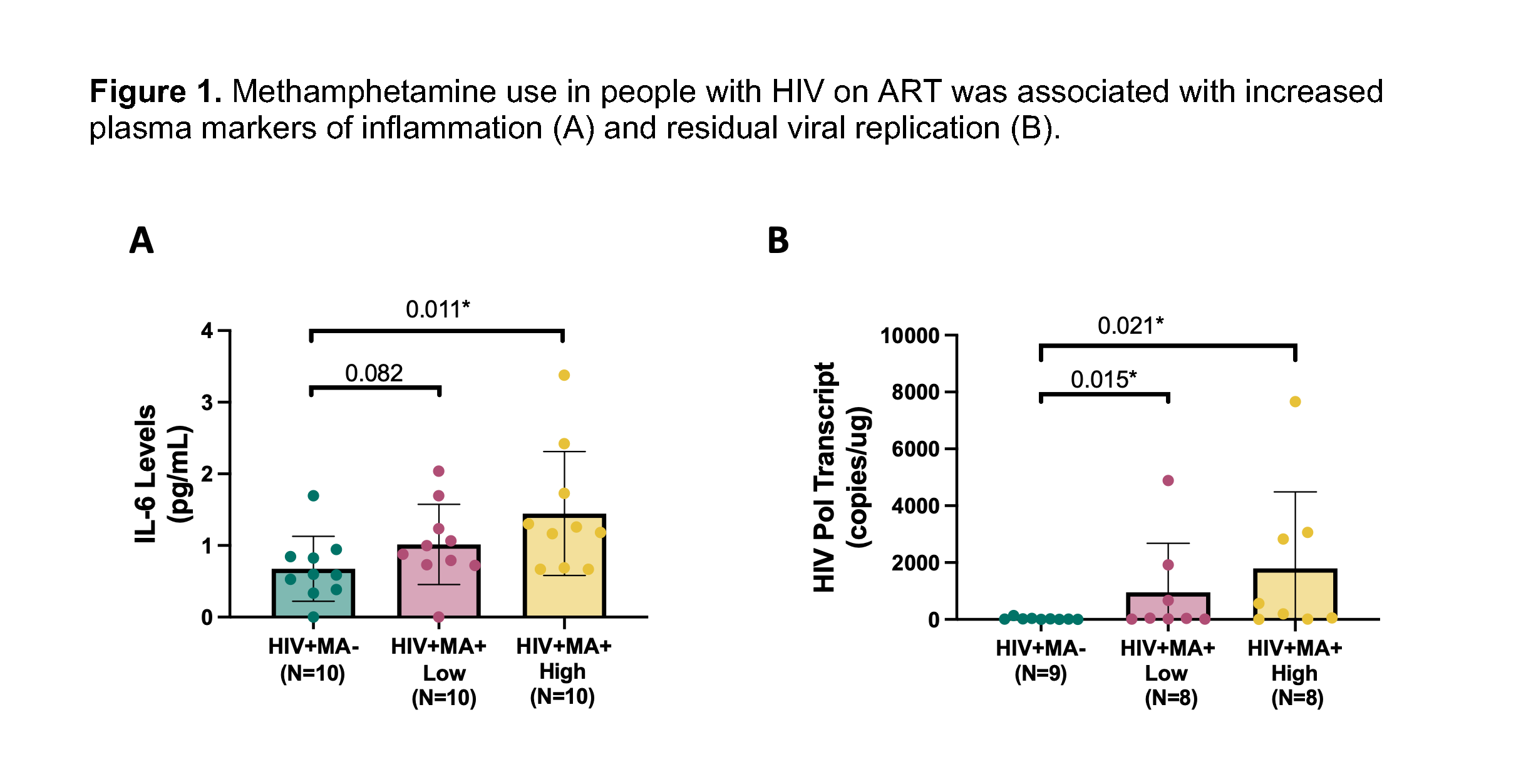
HIV+MA+ and HIV+MA- groups were balanced by age, gender, race/ethnicity, nadir CD4+ T cell count, and duration of ART. Among the 43 analytes, only TNF-α, TNF-β, IL-6, and MIP-1α and IFN-β were significantly higher in HIV+MA+ vs. HIV+MA- individuals, and these associations (except IFN-β) remained statistically significant in multivariate models adjusted for nadir CD4+ T cell count and duration of ART (P<0.05). HIV RNA transcripts were detectable in a total of 17 participants. HIV Pol transcripts were significantly higher in 8 HIV+MA+ vs. 9 HIV+MA- participants.
Conclusions:
To our knowledge, this small pilot study is the first human study to evaluate the impact of MA use on circulating cytokine levels and the HIV reservoir during suppressive ART. MA has been shown in animal and in vitro studies to increase T cell activation and exhaustion and enhance HIV transcription. Our findings suggest that even during ART suppression, PWH who use MA may have higher levels of systemic inflammation and residual HIV transcription.