Background:
To accomplish goals of the Ending the HIV Epidemic in the U.S. initiative, increased PrEP uptake is needed especially in jurisdictions with higher HIV incidence. Expanded Medicaid eligibility and enrollment can provide PrEP financial access for persons who otherwise might not be able to afford its cost. The Affordable Care Act of 2010 included a provision for states to expand Medicaid coverage starting in 2014. Since then, 41 states and the District of Columbia have expanded Medicaid access. Our objective was to estimate the association between state Medicaid expansion and the use of PrEP.
Methods:
We analyzed national Medicaid data from the Centers for Medicare and Medicaid Services to estimate the PrEP-to-Diagnosis Ratio (PDR) among persons aged 16 years and older from 2017–2022. The PDR is a measure of PrEP coverage that estimates the need for increased PrEP implementation. It was calculated as the annual number of persons prescribed PrEP divided by the annual number of new HIV diagnoses. We identified persons prescribed PrEP using a validated algorithm with diagnostic and drug codes. We identified persons with newly diagnosed HIV using ICD diagnosis codes for HIV. We categorized states and the District of Columbia in three cohort groups based on the year they expanded Medicaid: before 2017, 2017–2021, and never. We calculated the estimated annual percentage change (EAPC) and 95% confidence intervals (CIs) for PDR trends by state Medicaid expansion cohort.
Results:
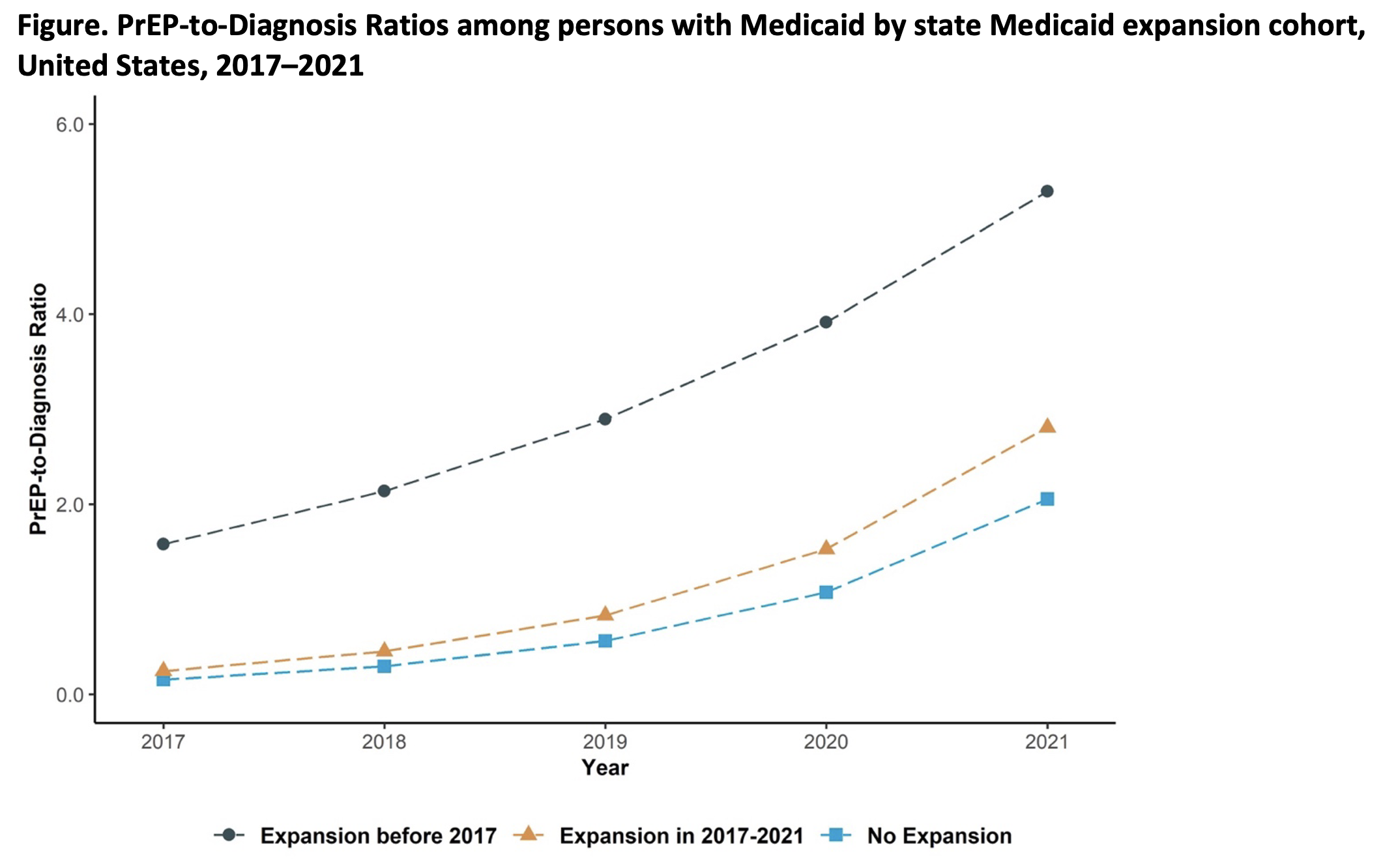
Among persons with Medicaid, the overall number of persons prescribed PrEP increased from 24,279 in 2017 to 53,434 in 2021. Among 32 states that expanded Medicaid before 2017, the PDR was 1.6 in 2017 and increased to 5.3 by 2021 with an EAPC of 35.3 (95% CI 35.3, 35.3) (Figure). Among 7 states that expanded Medicaid in 2017 through 2021, the PDR was 0.2 in 2017 and 2.8 by 2021 with an EAPC of 83.8 (83.3, 84.2). Among 12 states that did not Medicaid before 2022, the PDR was 0.2 in 2017 and 2.1 by 2021 with an EAPC of 91.0 (90.9, 91.1).
Conclusions:
Our study found that expansion of Medicaid was associated with increased PrEP coverage among persons with Medicaid insurance, suggesting that Medicaid expansion is an effective policy to increase access to HIV prevention services. Medicaid expansion can provide access to many services, including PrEP, that protect the health and wellbeing of the U.S. population.