Background:
Globally, transgender women continue to face a high burden of HIV. In Peru, there has been no decrease in the incidence of HIV among transgender women over the last 15 years. Better understanding homelessness among young transgender women is critical to inform HIV prevention and treatment strategies and to ending the HIV epidemic. We sought to estimate the proportion of young transgender women experiencing homelessness and the associations between homelessness, HIV-related vulnerability, and PrEP willingness.
Methods:
We recruited young transgender women aged 16-24 through peer workers to participate in a biobehavioural survey and testing for HIV and other STIs (chlamydia, syphilis, gonorrhea, hepatitis B). Poisson regression with robust standard errors was used to estimate the association between past experiences of homelessness and HIV-related outcomes, adjusted for potential confounding by age and education.
Results:
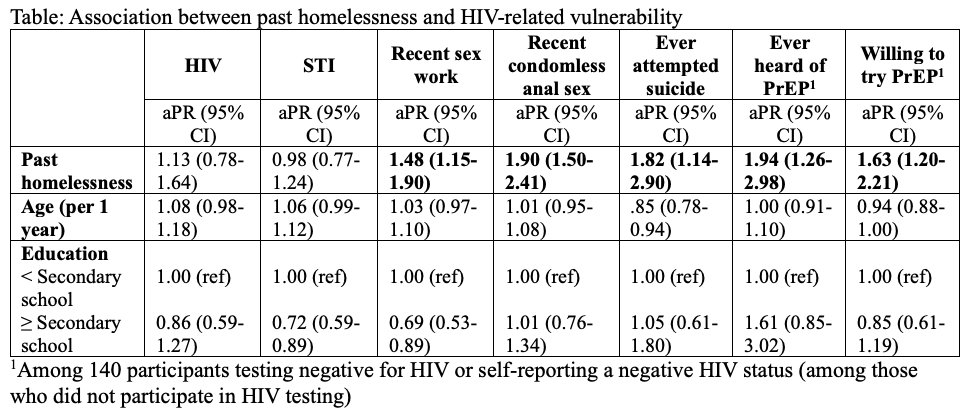
A total of 211 young transgender women participated in the study, of whom 156 completed HIV and STI testing. The median age of participants was 23 years, 72.7% had completed secondary school, and the overall prevalence of HIV was 41.5%. A total of 64 participants (30.6%) had been homeless at least once in their life and 4.8% has been homeless in the past 30 days. Currently 35.9% lived in their own apartment or room, 27.7% stayed in a relative’s home, and 34.0% stayed with a friend or sexual/romantic partner. Among participants who tested positive for HIV, 35.8% reported past homelessness compared to 31.6% of those testing negative for HIV (p = 0.69). After adjusting for age and education, past homelessness was not associated with testing positive for HIV or other STIs but did increase risk of recent (past 30 days) sex work (aPR = 1.48, 95% CI: 1.15 – 1.90), condomless anal sex in the past 6 months (aPR = 1.90, 95% CI: 1.50-2.41), and ever attempting suicide (aPR = 1.82, 95% CI: 1.14-2.90). Among HIV-negative participants, homelessness was associated with having heard of PrEP (aPR=1.94, 95% CI: 1.26-2.98) and willingness to try oral PrEP (aPR=1.63, 95% CI: 1.20-2.21).
Conclusions:
The prevalence of past homelessness is high among sampled transgender women aged 16 to 24 and past experiences of homelessness can elevate HIV vulnerability. HIV prevention and treatment programs for transgender women, particularly youth, must consider past and on-going experiences of homelessness to reduce barriers to program access that persist despite interest and willingness to engage.