Background:
The initiation of antiretroviral therapy (ART) early in HIV infection results in a rapid decline in viral load (VL) and a small HIV reservoir. However, children treated early face long-term challenges to maintaining viral suppression. We studied the longer-term VL dynamics of a cohort of early treated children.
Methods:
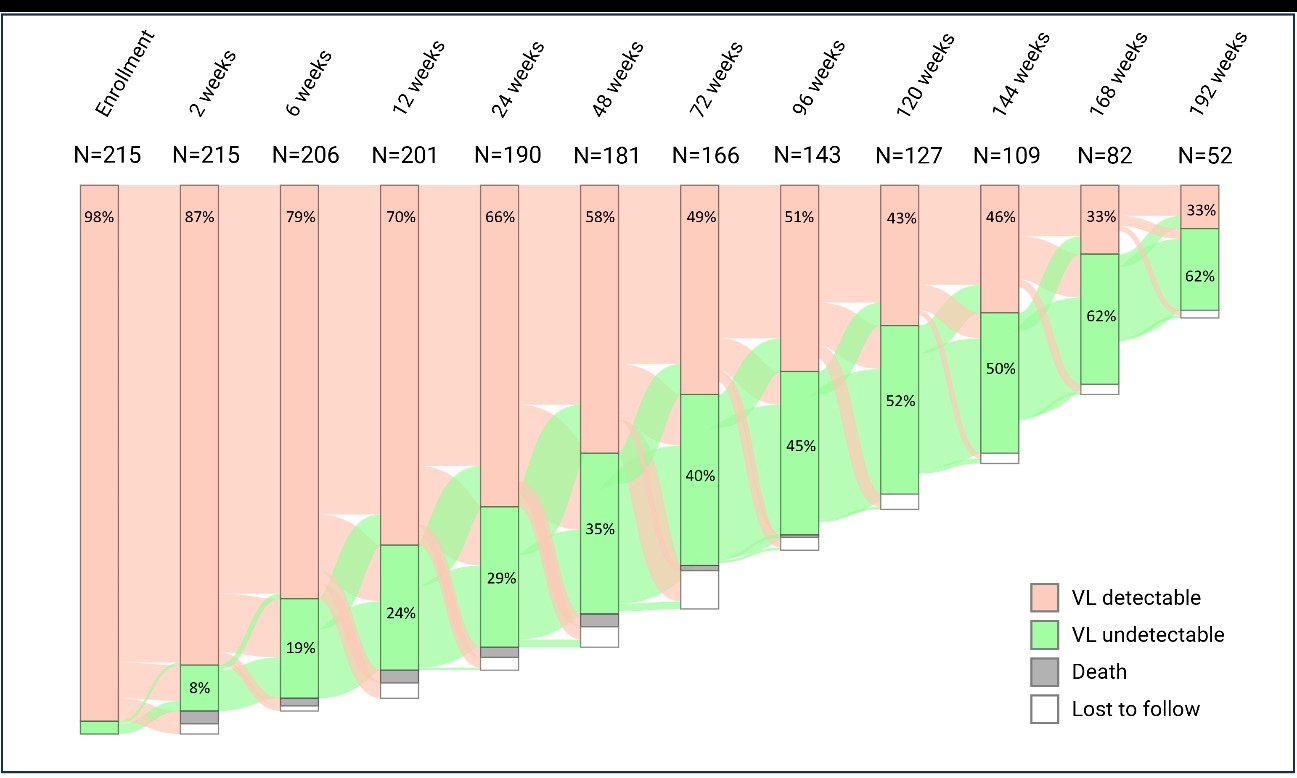
From May 2018 to May 2021, we enrolled infants initiating ART within 6 months of birth and within 3 months of diagnosis in six sites from 3 African countries. We represented VL status transitions with Sankey plot.
Results:
Of 215 infants enrolled, the median age at HIV diagnosis was 31 days [0; 48]. The median age at ART initiation was 34 days [26;73]. The most common starting ART regimen was Lamivudine + Abacavir + Lopinavir/ritonavir in 140/215 (65%), 10% switched to DTG in 2021. Median VL at ART initiation was 4.9 log10 copies/mL [3.6;5.8]. Median follow-up duration at analysis was 34.0 months [IQR, 16.3;44.1]. Twenty-five children (11.6%) died, 51/215 (23.7%) completed 4 years of follow-up, 76/215 (35.3%) remained in care and 63/215 (29.3%) were lost to follow-up. A total of 58.0% and 51.1% of children had detectable VL at 1 year and 2 years year of follow-up, respectively. Ninety-eight of 193 infants (50.7%) achieved virologic suppression at some point during the study. Among these, the median time to suppression (ART initiation to two consecutives undetectable VLs) was 5.5 months [IQR, 2.1-15.6]. Over time, the proportion of children with undetectable VLs increased, but a median of 19.1% switched from undetectable to undetectable VLs during follow-up visits. Notably, most patients who died or were lost to follow-up had detectable VLs in previous visits.
Conclusions:
Undetectable VL increased across time, but oscillations between undetectable and detectable VL in the long term were frequent. This underscores the need for further investigations to assess the potential clinical implications of these fluctuations on patient outcomes and the size of the viral reservoir.