Background:
The teratogenicity of antiretroviral medications (ARVs) is a key consideration in clinical recommendations and prescribing decisions for HIV regimens used during pregnancy. However, in the U.S., data on the association between ARV exposures and major congenital anomalies are generally limited to older ARV agents, many of which are now rarely used. Given the timing of organogenesis, it is critical to assess the safety of first-trimester fetal exposure to newer ARVs.
Methods:
We evaluated the association between first trimester exposure to newer ARVs and major congenital anomalies among infants born between 2012-2022 to pregnant persons with HIV enrolled in the U.S.-based prospective Surveillance Monitoring for ART Toxicities (SMARTT) study conducted by the PHACS network. First trimester exposures to newer ARVs were abstracted from maternal medical records. Trained study site staff conducted physical exams and abstracted congenital anomalies from infant medical records, and investigators classified the anomalies using the Metropolitan Atlanta Congenital Defects Program classification system. The prevalence of major congenital anomalies identified by age 1 year was estimated for infants exposed and unexposed to each ARV. Generalized estimating equation (GEE) models were used to estimate the odds ratio (OR) and confidence interval (CI) of major congenital anomalies for each ARV exposure compared to those unexposed to that ARV, adjusting for infant birth year, maternal age at delivery, pre-pregnancy BMI, pregestational diabetes, and first trimester alcohol use, and accounting for correlation among siblings and/or multifetal births.
Results:
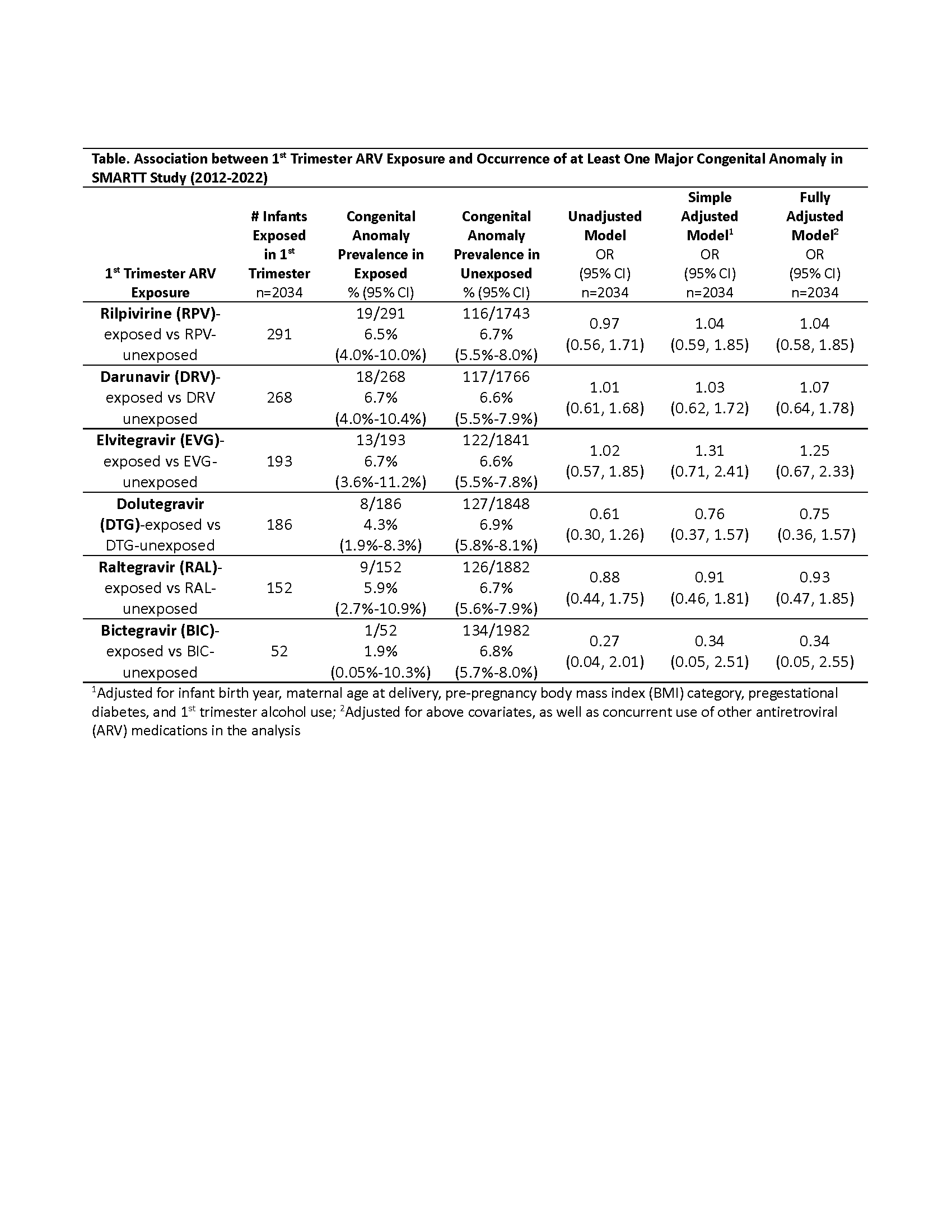
Of 2034 eligible infants, major congenital anomalies occurred in 135 (6.6%; 95%CI: 5.6%-7.8%). Cardiovascular (n=43) and musculoskeletal (n=37) anomalies were most common. The adjusted odds ratios (95% CI) of congenital anomalies were 1.07 (0.64-1.78) for darunavir, 0.93 (0.47-1.85) for raltegravir, 1.04 (0.58-1.85) for rilpivirine, 1.25 (0.67-2.33) for elvitegravir, 0.75 (0.36-1.57) for dolutegravir, and 0.34 (0.05-2.55) for bictegravir (see Table). Findings were similar after adjustment for nucleoside backbones in the ARV regimen.
Conclusions:
The odds of congenital anomalies among infants with first trimester exposure to newer ARVs did not differ substantially from that among infants unexposed to these specific ARVs. However, modest effects cannot be ruled out, highlighting the need for continued evaluation of these associations in larger populations.