Background:
Immunosuppressed adults (primary immunodeficiency (PI), HIV (unsuppressed and poor immune recovery), and solid organ transplant) are more likely to have severe COVID-19 and poor outcomes. Less is known about outcomes of severe COVID-19 for adults with specific immunosuppressive conditions compared to immunocompetent adults. We hypothesized that outcomes for adults with certain immunosuppressive conditions hospitalized for COVID-19 would be significantly worse.
Methods:
We identified adults hospitalized for COVID-19 from 03/2020 to 05/2022 in EHR data from Northwestern Medicine (NM). Based on extracted diagnosis, lab, and procedure codes, we identified and categorized those with PI (antibody deficiency, combined immunodeficiency, common variable immunodeficiency, ataxia-telangiectasia, phagocyte deficiency, or complement deficiency), history of organ transplant (kidney, liver, heart, or lung), and HIV (defined above). Assessed COVID-19 outcomes included a seven-point ordinal severity scale based on maximum oxygen requirements during care (1 = Death), hospitalization length, and one-year cumulative incidence of death (all-cause). Regression and relative risk analyses were performed in R 4.2.0.
Results:
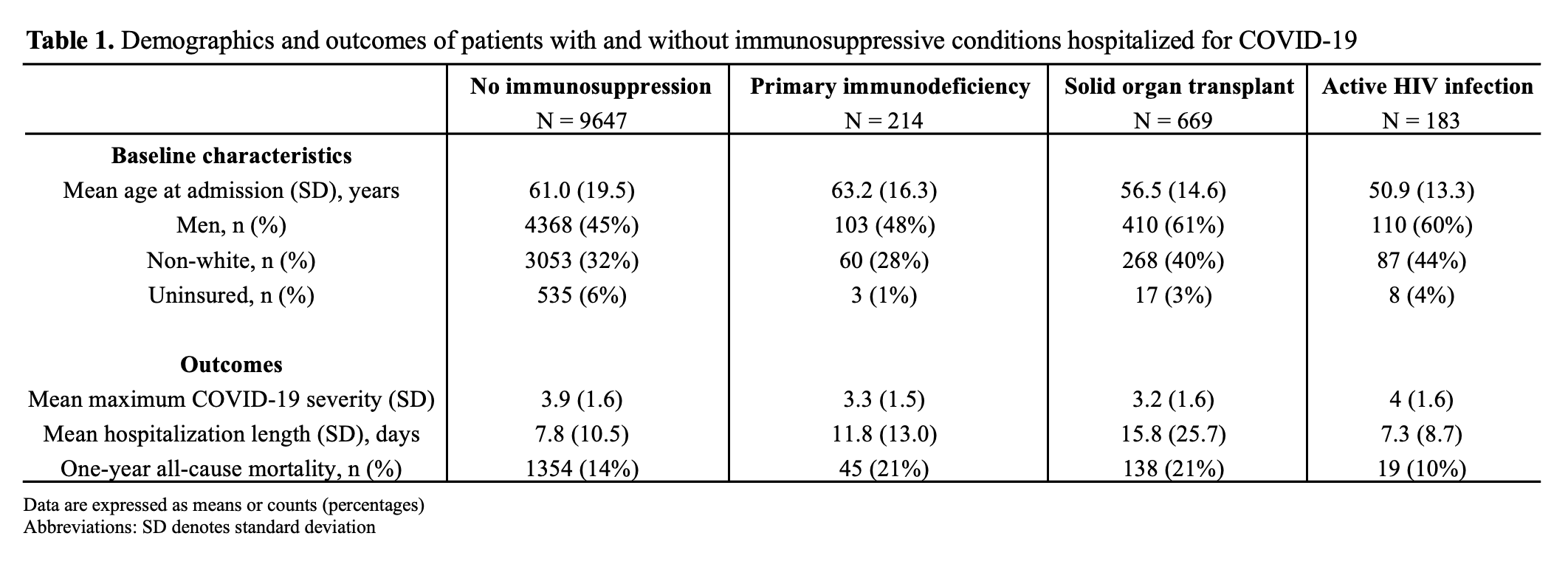
We included 10,713 adults hospitalized for COVID-19 at NM of which 214 had PI, 669 had history of organ transplant, and 183 had HIV (defined above). Patients with PI had a significantly higher mean hospitalization length of 11.8 days and a significantly lower mean maximum severity of 3.3 compared to 7.8 days and 3.9 in immunocompetent patients when controlling for obesity and T2DM. These effects were not significant when controlling for age. Patients with organ transplant had a significantly higher mean hospitalization length of 15.8 days when controlling for obesity, T2DM, and age, and a significantly lower mean maximum severity of 3.2 when controlling for obesity. Significantly higher mortalities were observed in PI and transplant (RR = 1.5, 95% CI 1.2 to 2.0; RR = 1.5, 95% CI 1.3 to 1.7), but these effects were not significant when controlling for age. There were no significant differences in any outcomes for patients with HIV.
Conclusions:
Our results suggest patients with PI or organ transplant hospitalized for COVID-19 may have worse clinical outcomes compared to immunocompetent patients. This contrasts with patients with HIV, who had similar outcomes to immunocompetent patients, suggesting that people with different immunosuppressive phenotypes may respond variably to severe COVID-19.