Background:
Mortality associated with hypertension (HTN) in sub-Saharan Africa is among the highest globally and unlike other regions, little progress has been made in diagnosis, treatment, and control. HIV care programs have typically focused on providing HIV-related care, but as life expectancies of people with HIV (PWH) are extending, addressing noncommunicable diseases and risk factors may be increasingly important.
Methods:
The prospective African Cohort Study enrolls PWH and people without HIV (PWoH), aged ≥15 years, in care at 12 PEPFAR-supported facilities in Kenya, Nigeria, Tanzania, and Uganda. Among participants with at least two 6-monthly study visits, we defined HTN as a persistently elevated systolic and/or diastolic blood pressure (BP) ≥140/90 mmHg at ≥2 consecutive visits, or receipt of any HTN medication. All subsequent study visits were classified as having HTN. Multivariable random intercept log-Poisson models with robust standard errors that included HIV status, time in the cohort, demographic and clinical characteristics, and site service delivery characteristics were used to examine associations with study visit-level rates of untreated HTN and uncontrolled BP (≥130/80 mmHg) among those on HTN treatment.
Results:
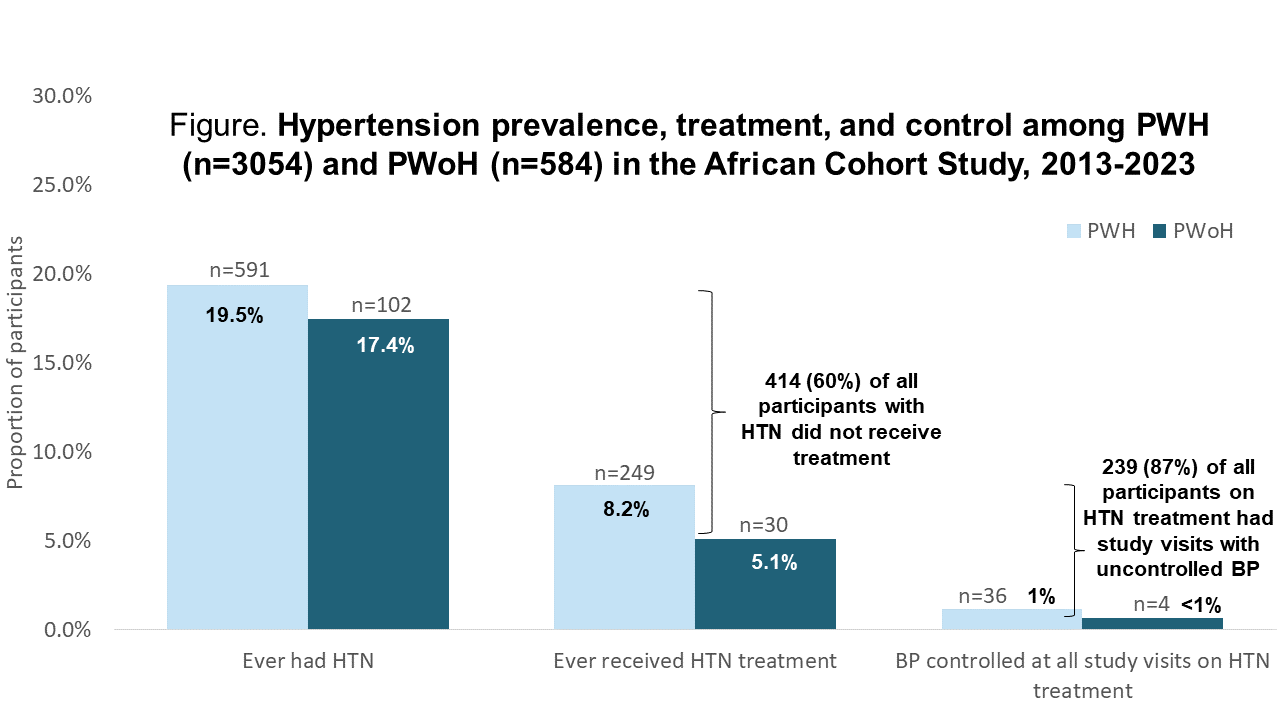
From 1/2013–6/2023, 4114 participants were enrolled; 3638 with a total of 19,507 person-years of follow-up were included. Overall, 693 (19%) ever had HTN, among whom median (IQR) age was 48 (41–54) years, 591 (85%) were PWH, and 380 (55%) were female. Of those with HTN, 414 (60%) never received HTN treatment (figure). Among those on HTN treatment, 87% had one or more study visits with uncontrolled BP, with a median (IQR) proportion of study visits with uncontrolled BP of 73% (43%–100%). At their most recent study visit, 158 (57%) of those on HTN treatment received combination therapy as recommended by WHO guidelines. In multivariable models, HIV status was not significantly associated with untreated HTN (PWH vs. PWoH: adjusted rate ratio [aRR] 0.93, 95% CI: 0.84–1.03) or uncontrolled BP (PWH vs. PWoH: aRR 0.97, 95% CI: 0.81–1.17). Males had a significantly higher rate of untreated HTN (aRR 1.18, 95% CI: 1.08–1.28), but not uncontrolled BP (aRR 1.10, 95% CI: 0.96–1.26).
Conclusions:
We identified a substantial burden of untreated and uncontrolled HTN, unaffected by HIV status. Strategies are needed to optimally scale up HTN diagnosis and management in the context of existing HIV treatment services for PWH and testing/prevention services for PWoH.