Background:
Several antiretroviral therapy (ART) agents are associated with increased risk of cardiovascular disease but less is known about the safety of contemporary ART. We sought to compare the risk of major adverse cardiac events (MACE) between different ART regimens.
Methods:
We used the Merative™ MarketScan® Commercial (2008-2020) and Multistate Medicaid (2011-2020) databases to identify adults between 18-64 years of age who newly initiated a stable ART regimen. We excluded people with MACE prior to and within 90 days after ART initiation. Nucleoside reverse transcriptase inhibitor (NNRTI)-based regimens were compared to protease inhibitors (PI) and integrase inhibitors (INSTI) at class-level as well as to individual INSTI drugs. We used propensity score-weighted Kaplan-Meier functions to estimate the 6, 12, 18, 24, 36, and 48-months risks and risk differences (RD) for MACE. Secondary analyses including use of tenofovir or abacavir were performed.
Results:
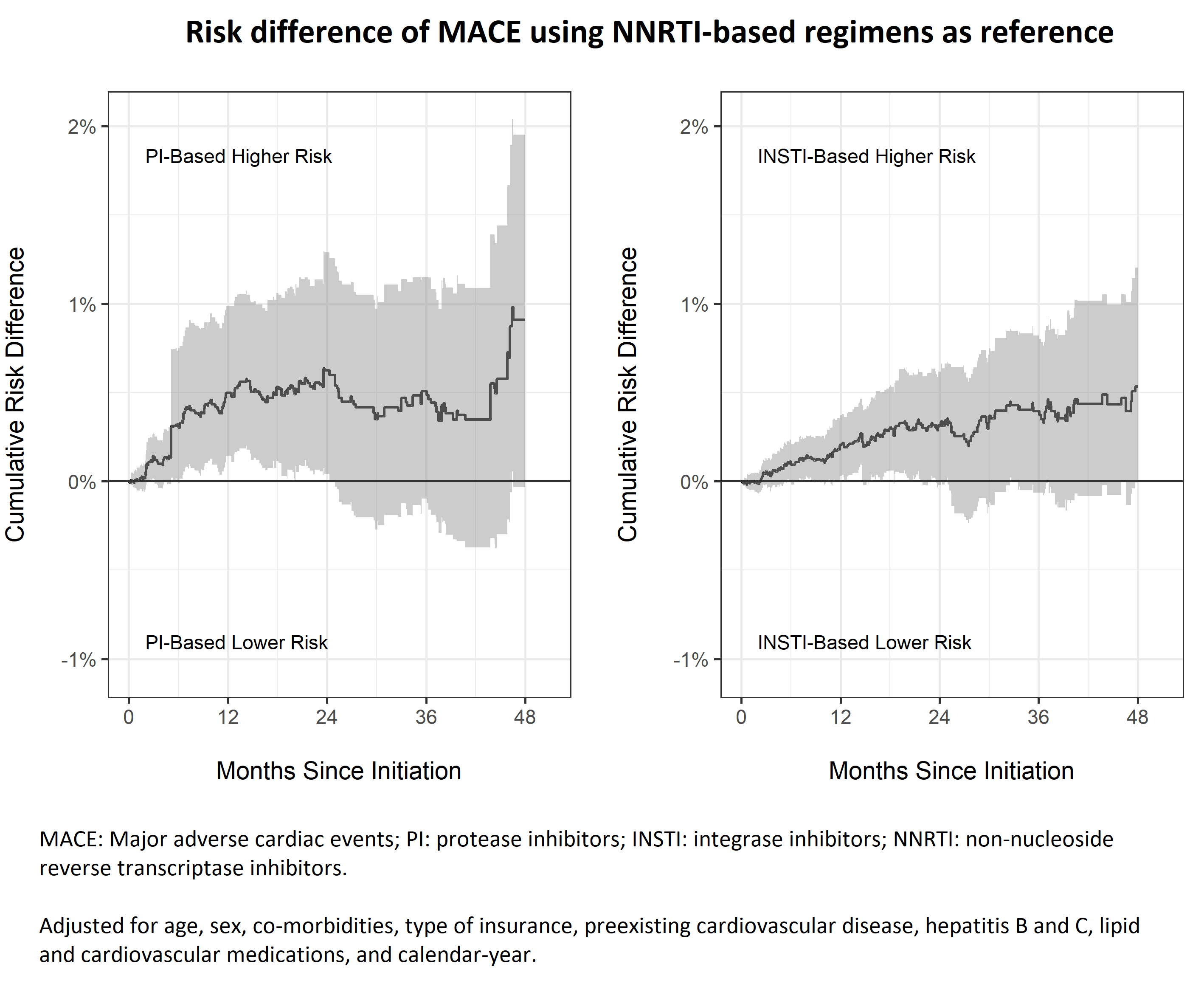
Among 37,935 new ART initiators, mean age was 40±11 years. The distribution of ART regimens was 45% INSTI- (14% raltegravir, 40% elvitegravir, 30% dolutegravir, and 16% bictegravir), 39% NNRTI-, and 16% PI-based regimen. INSTI initiation increased from 5% in 2008 to 97% in 2020. The median (IQR) follow-up for those starting INSTI-, NNRTI-, and PI-based regimens was 442 (224, 894), 521 (239, 1109), and 429 (212, 932) days, respectively. MACE occurred in 418 individuals (1.1%) over the study period. The highest risk of MACE occurred with PI-based regimens followed by INSTI and NNRTI. Compared to NNRTI initiators, the risk of MACE was higher at 12 months [RD 0.50, 95% CI (0.14, 0.99)], 18 months [RD 0.53, 95% CI (0.11, 1.06)] and 24 months [RD 0.62, 95% CI (0.04, 1.29)] for the PI-group, and at 12 months [RD 0.20, 95% CI (0.03, 0.37)] and 18 months [RD 0.31, 95% CI (0.06, 0.54)] for INSTI initiators; the precision of estimates was limited in later months of follow-up. Risk of MACE did not differ by individual INSTIs, tenofovir, or abacavir use.
Conclusions:
In this large-scale study using U.S. claims databases, PI-based and INSTI-based regimens were associated with higher risk of MACE compared to NNRTI-based regimens after ART initiation, and the pattern of association between INSTIs and PIs with excess risk of MACE was similar.