Background:
In patients with chronic HBV infection, the immune response is inadequate for HBV clearance but can cause a persistent inflammatory reaction. Alleviating hepatitis may be possible by inhibiting the function of inflammatory cells during hepatitis activity. The potential for interleukin 21 (IL-21) to suppress liver inflammation by regulating the suppressive activity of myeloid-derived suppressor cells (MDSCs) on T cell response is not well understood.
Methods:
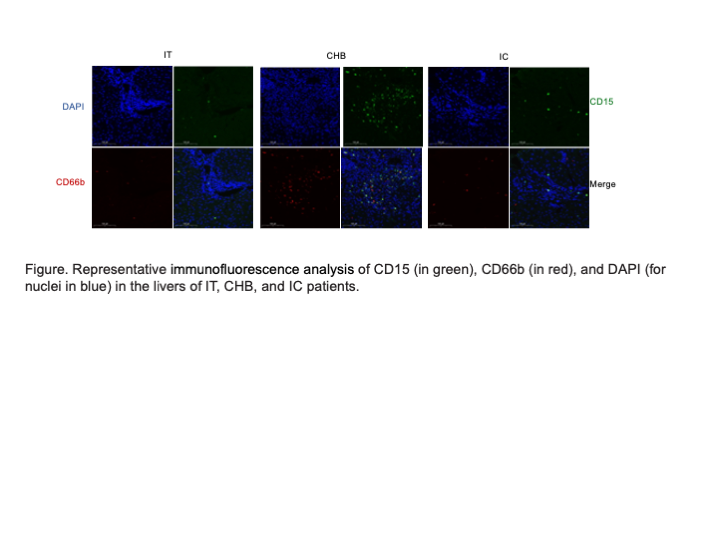
Eighty treatment-naïve patients with chronic HBV infection were recruited and classified into the immune tolerant carrier (IT; n = 37), hepatitis B e antigen (HBeAg)-positive chronic hepatitis B (CHB; n = 16), and inactive carrier (IC; n = 27) groups according to the American Association for the Study of Liver Diseases guidelines. Another 33 healthy controls (HCs) were also enrolled in this study. We investigated the characteristics of MDSCs and the effect of IL-21 on the phenotype and function of MDSCs by flow cytometry. The quantity of granulocytic MDSCs (gMDSCs) in the human liver was analyzed by immunofluorescence assay. Wild-type C57BL/6 mice were used to establish a hydrodynamic injection HBV mice model.
Results:
The frequency of circulating MDSCs in patients infected with chronic HBV was higher than that in the HC group. The circulating MDSCs frequency was negatively correlated with the serum levels of ALT and AST. The number of CD15 and CD66b double-positive cells indicating gMDSCs in CHB patients was higher than that in IT and IC patients. Exogenous IL-21 promoted MDSCs differentiation into M2-like macrophages while also increasing their expression of Arginase I. IL-21 also enhanced the suppressive activity of MDSCs in inhibiting the expression of IFN-γ in T cells. Hydrodynamic injection HBV mice model injected with IL-21 plasmid showed lower ALT concentration and higher production of Arginase I in MDSCs than mice injected with blank plasmid.
Conclusions:
Our study highlights the robust immune-suppressive activity of MDSCs, which can be enhanced by exogenous IL-21, and their potential role in protecting against liver inflammation in chronic HBV infection. These findings provide a novel perspective on the involvement of IL-21 in the negative regulation of intrahepatic inflammation and have implications for the development of immunotherapeutic strategies to optimize the available anti-inflammatory hepatinica in chronic HBV infection.