Background:
Because inflammation is associated with mortality and has been linked to HIV transcription in lymphoid tissues during ART, it is necessary to address the long-term effects of switching ART regimens with different numbers of antiretrovirals on inflammation.
Methods:
In this interim analysis of the randomized, open-label, multicenter INSTINCT trial (clinicaltrial.gov: NCT04076423), we evaluated the effect of switching from DTG/3TC to BIC/FTC/TAF vs. remaining on DTG/3TC on systemic inflammation up to 48 weeks. Participants were adults with confirmed, virologically suppressed HIV, on stable ART with DTG/3TC for a minimum of 48 weeks. Exclusions included previous virological failure, drug resistance, and autoimmune conditions. We focused on IL-6 changes from baseline to week 48 using high-sensitivity ELISA. IL-6 levels were analyzed using Mann-Whitney tests and linear regression adjusted for potential confounders in R studio.
Results:
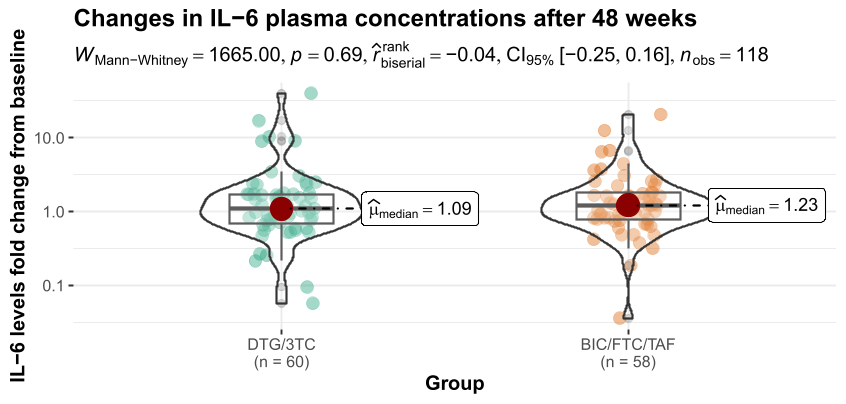
A total of 118 patients with available week 0 and 48 plasma samples were included; 17% women, mean age 44 ± 11 years, 79% white, 62% MSM, 9% with past AIDS diagnosis, median nadir CD4 338 cells/uL, baseline CD4 counts 776/uL, median duration of HIV suppression 5.2 years, median IL6 levels within normal range (0.96 pg/mL [0.53-1.44]).. No differences were observed in the general characteristics between groups. No significant differences in IL-6 changes were observed between groups from week 0 to 48 (median fold change for DTG/3TC, 1.1 [0.7-1.7]; for BIC/FTC/TAF, 1.2 [0.8-1.8], P = 0.688)(Figure 1). Multivariate linear regression analyses corroborated these findings (Coef -0.07, P = 0.931).
Conclusions:
This analysis revealed no significant impact on IL-6 levels when switching from DTG/3TC to BIC/FTC/TAF after 48 weeks. These preliminary findings suggest a neutral inflammatory effect for the ART switch, warranting further study to elucidate the longer-term influence on inflammation.