Background:
Central nervous system infections (CNSI) account for approximately 30% of early mortality in ART programmes. The epidemiology of CNSI in high-HIV prevalence African settings is poorly understood making presumptive diagnosis and empiric treatment challenging. Patients with CNSI who do not receive a diagnosis have mortality rates of up to 40% at 10 weeks indicating the presence of serious underlying pathology that needs appropriate diagnosis to guide effective treatment.
Methods:
Enhanced diagnostic packages were introduced into routine CSF analysis at Princess Marina Hospital, Gaborone, Botswana in June 2021 and Parirenyatwa Hospital, Harare, Zimbabwe in October 2022. BioFIRE FilmArray-Meningitis/Encephalitis (FilmArray-ME) & Xpert MTB/RIF Ultra were performed on all samples and results returned to clinicians in real-time. Retrospective analysis was performed on stored samples with Toxoplasma gondii PCR & rapid plasma reagin, Treponema pallidum particle agglutination assay, and metagenomic sequencing.
Results:
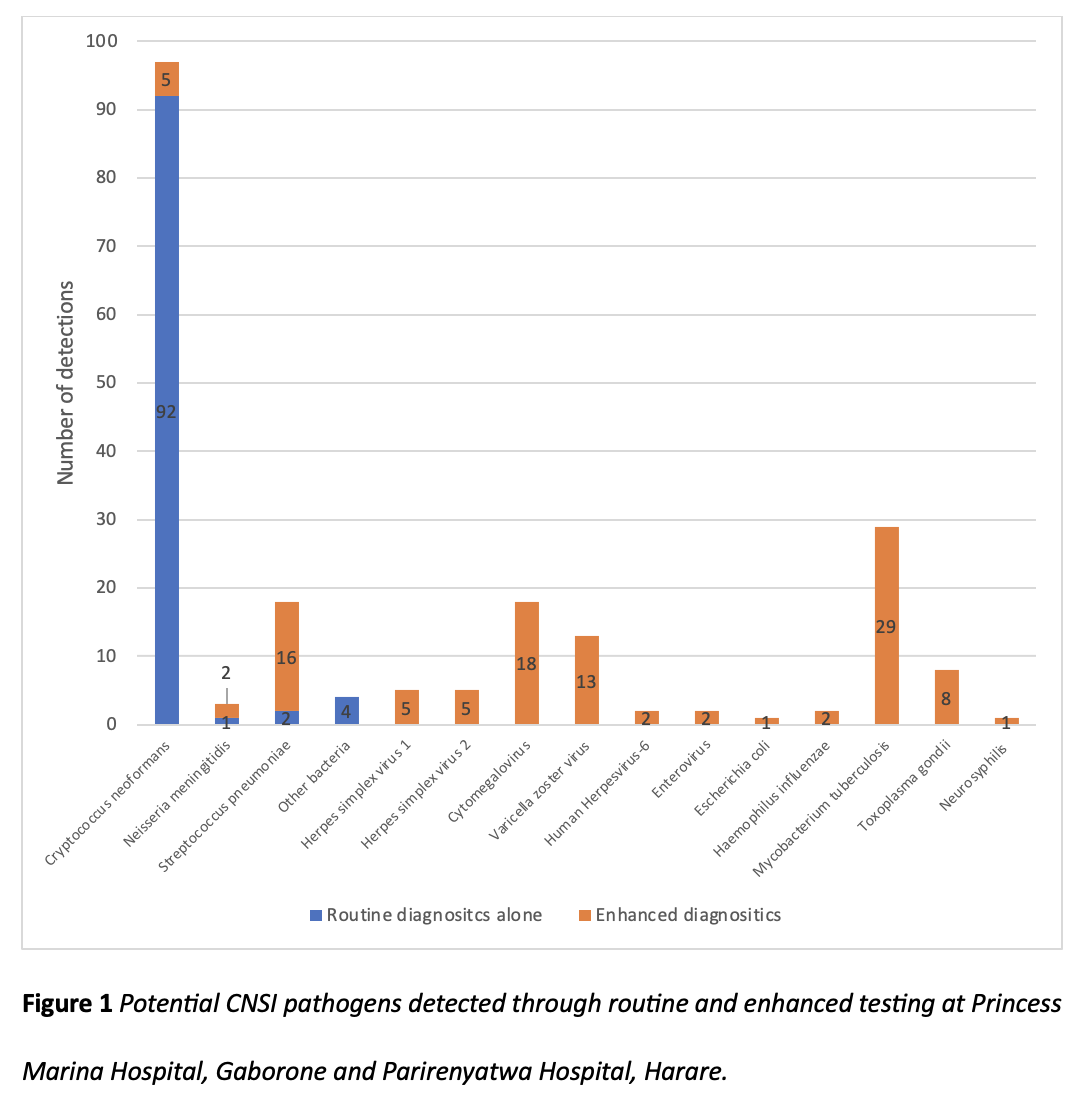
Sequential CSF samples from 465 people living with HIV with suspected CNSI underwent analysis with FilmArray-ME and 454 had analysis with Xpert MTB/RIF Ultra. The median age of study participants was 40 (IQR 34-48), 54.4% were male, and the median CD4 count was 114 cells/L (IQR 43-325); 49.0% (220/465) were established on ART the remainder were either ART naïve or had cycled out of treatment services. Through routine CSF analysis alone there were 99 microbiologically confirmed CNSIs; with the addition of enhanced diagnostics this increased to 155 (Figure 1), a relative increase of 57%. Detection of Mycobacterium tuberculosis, T. gondii and viral pathogens was only achieved through the addition of enhanced diagnostics. Cryptococcal meningitis was the most commonly diagnosed CNSI in 97/465 patients with 92/97 diagnoses made through cryptococcal antigen (CrAg) testing or India ink, figure 1. Restricting analysis to CrAg negative patients, only 11 CNSI diagnoses were made through routine analysis compared to 62 diagnoses made with the addition of enhanced diagnostics, a relative increase of 464%.
Conclusions:
Enhanced diagnostic platforms substantially increased diagnostic yield in patients with suspected CNSI in Botswana and Zimbabwe. There was significant variation between population groups suggesting targeted use may be possible. The most clinically and cost-effective diagnostic algorithms need to be defined.