Background:
Long COVID (LC) affects about 10% of persons infected with severe acute respiratory coronavirus 2 (SARS-CoV-2) and can have serious clinical consequences. Whereas the pathophysiology of LC is likely multifactorial, several hypotheses have been proposed, including viral persistence in some individuals for months following the acute phase of COVID-19. Herein, we analyzed existing human RNA transcriptome datasets from people with and without LC to identify unique phenotypic fingerprints of LC.
Methods:
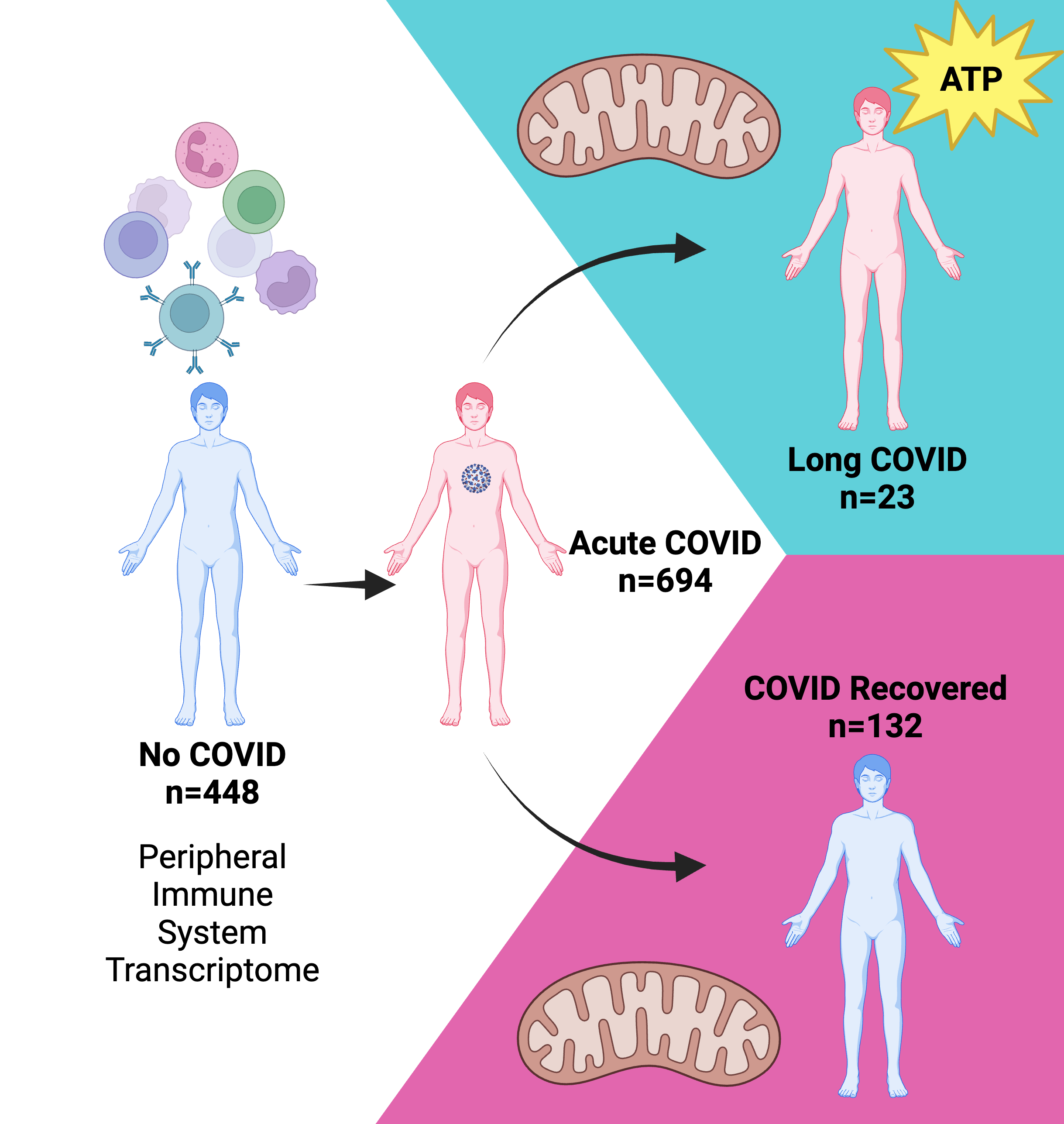
We analyzed 28 publicly available RNAseq datasets from COVID-19 acute and convalescent studies. Differentially expressed genes and gene ontology analysis between No known COVID (NC) (n = 448), Acute COVID (AC) (n = 694), COVID Recovered (CR) (n = 123), and LC (n = 23) were examined. All samples underwent processing using the STAR Aligner and GRCh38 reference genome. DESeq2 identified differentially expressed genes, and the most significant genes were distilled through Gene Ontology and Reactome to identify pathways. We accounted for batch effects between the studies by including ‘study’ as a covariate in the DESeq2 analysis.
Results:
The cohort comparison between NC and AC revealed global changes in nucleosome assembly (p.adj = 1.23e-24), chromatin remodeling (p.adj = 1.39e-13), and defense response to virus (p.adj = 0.0027), among others. Comparisons of AC to CR or LC showed a transcriptome signature enriched in mitochondrial genes. LC differed from CR in an increase in genes explicitly related to the electron transport chain and ATP synthesis. Further, the most significantly over-expressed gene in the comparison of AC to LC was MGAT2 (Log Fold Change [LFC] = 6.02; p.adj. = 3.85e-22); which was considerably less expressed in AC compared to CR (LFC = 1.55; p.adj. = 1.45e-17). Reactome analysis additionally points to inhibited CASP8 activity in LC (p = 0.0358).
Conclusions:
RNA profiling of peripheral immune cells suggests that recovery from AC is driven by mitochondrial gene transcription. In contrast to recovery, LC correlated with electron transport chain-specific genes. These findings support our previous findings of increased oxygen consumption and ATP production in the peripheral immune cells in people with LC and further implies that host gene transcription drives this phenotype.