Background:
Cabotegravir (CAB) is an integrase strand transfer inhibitor approved in adults and adolescents (12 to <18 years) weighing >35kg as long-acting injectable (LAI) HIV-1 prevention, and for treatment in combination with rilpivirine. An existing CAB population pharmacokinetic (PopPK) model was limited to adult PK (Han 2023). We set out to extend and optimize that existing PopPK model for adolescents (12 to <18 years) by incorporating available adolescent PK data from the IMPAACT 2017/MOCHA (NCT03497676) and HPTN 083/084-01(NCT04824131/ NCT02720094) clinical trials.
Methods:
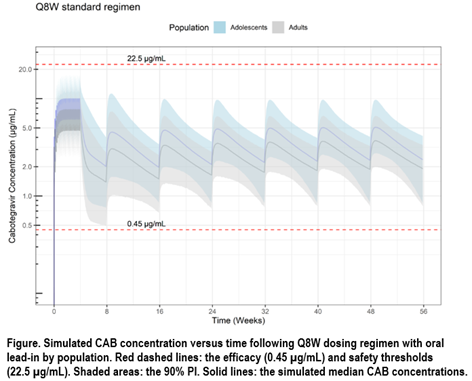
PK data following oral lead-in (30mg once daily, QD for at least 4 weeks) and LAI treatment (an initial 600mg 4-week loading dose followed by 400mg Q4W or 600mg Q8W) from 147 adolescents with HIV (IMPAACT 2017) and 62 HIV-negative adolescents (HPTN 083/084-01) with weight of 35.2-168 kg, body mass index (BMI) of 15.8-51.6 kg/m2 and 12 to 17 years were added to adult data (n=1647). The PopPK model parameters were re-estimated based on this pooled dataset using NONMEM 7.3. The updated PopPK model was used to simulate PK profiles for CAB for Q4W and Q8W regimens in adolescents and adults. Individual exposure metrics (e.g. Ctau,ss) were derived and compared between adolescents and adults.
Results:
A 2-compartment model with 1st-order absorption adequately described CAB PK in adolescents and adults. No new covariates were identified as compared to the adult PopPK model. Weight and smoking status were significant determinants of CL/F, and only weight was a determinant of Vc/F, Vp/F, and Q/F. Needle length, female sex, splitting of the injection, and BMI were significant determinants of KA IM (absorption rate for LAI). Adolescents had CAB LA exposure at steady state (Ctau,ss median, 5th-95th: 2.36, 0.849-4.13 µg/mL for 600mg Q8W) comparable to that of adults (Ctau,ss : 1.91, 0.786-3.33 µg/mL for Q8W), with their exposure levels falling within the same range across all dosing phases, and contained within the established efficacy and safety thresholds of 0.45 and 22.5µg/mL.
Conclusions:
The addition of adolescent data to the adult PopPK dataset allowed expansion of the prior PopPK model down to 35 kg and optimization of predictions in adolescents. Given the similarity of CAB PK across adolescents and adults, same dosing regimens apply for adults and adolescents.